

There’s a reason people linger outside on moonlit evenings. The light is soft. Shadows move gently. Everything feels calm and unhurried. Moonlight landscape lighting recreates that experience every night, regardless of the actual moon phase or cloud cover.
This technique involves mounting fixtures high in mature trees and aiming them downward so light filters through leaves and branches before reaching the ground. The result is a dappled, organic glow that feels completely natural. No glare. No harsh shadows. Just gentle illumination that makes outdoor spaces feel alive and inviting.
For homeowners in Newport Beach, Coto de Caza, Shady Canyon, and across Orange County, moonlight landscape lighting is one of the most effective ways to transform a backyard, patio, or garden into a space that feels as welcoming after dark as it does during the day. This guide covers how the moonlighting technique works, where to place fixtures, which trees are the best candidates, and how professional installation differs from DIY attempts.
What Is Moonlight Landscape Lighting?
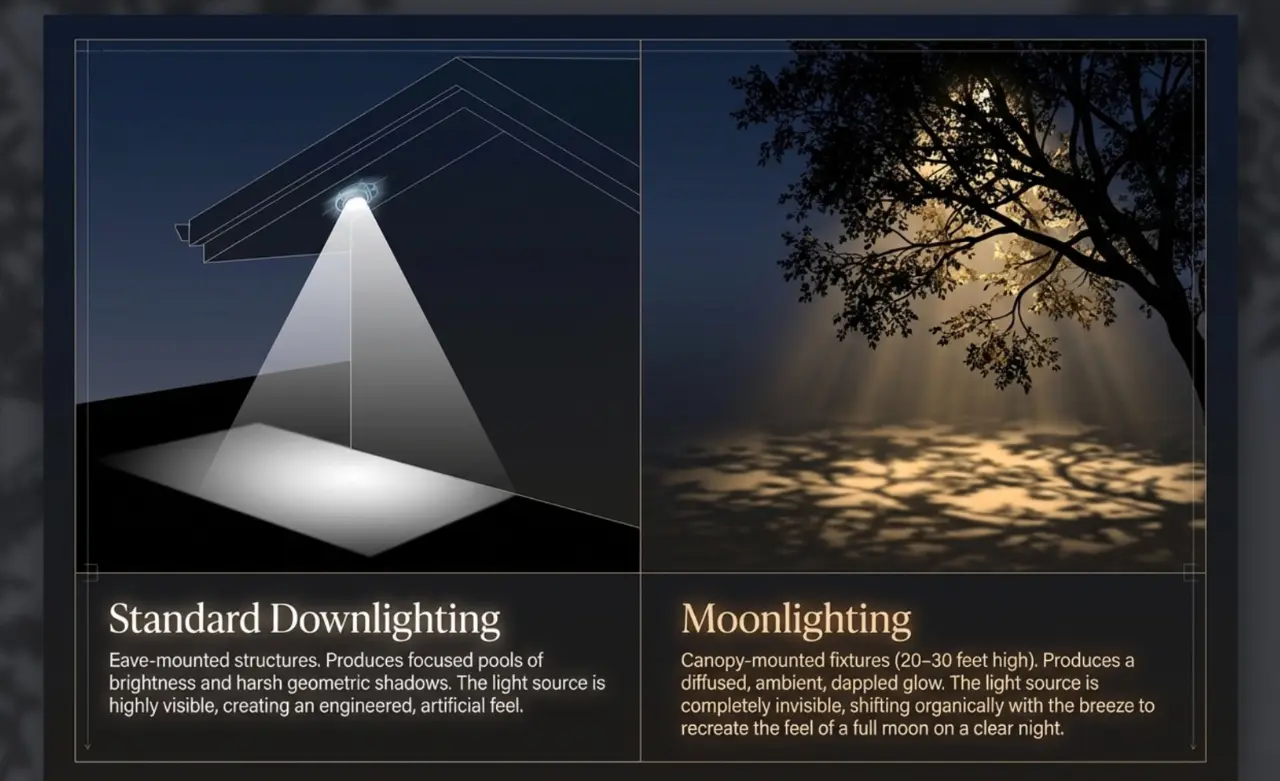
Moonlighting outdoor lighting is a specific downlighting technique where fixtures are installed 20 to 30 feet high in tree canopies and directed downward. As the light passes through branches and foliage, it breaks into soft, irregular patterns on the ground below, mimicking the way natural moonlight looks when it filters through a tree on a clear night.
Unlike standard downlighting landscape fixtures that create focused pools of brightness from eaves or structures, landscape moonlighting produces a diffused, ambient glow. The shadows shift with the breeze. Light and dark areas blend organically. The overall atmosphere feels more like nature than engineering.
This natural landscape lighting approach is popular on premium properties because it achieves something most outdoor lighting cannot: it creates atmosphere without any visible light source. Guests feel the effect without ever noticing where the light comes from.
How Moonlighting Works: The Technical Details
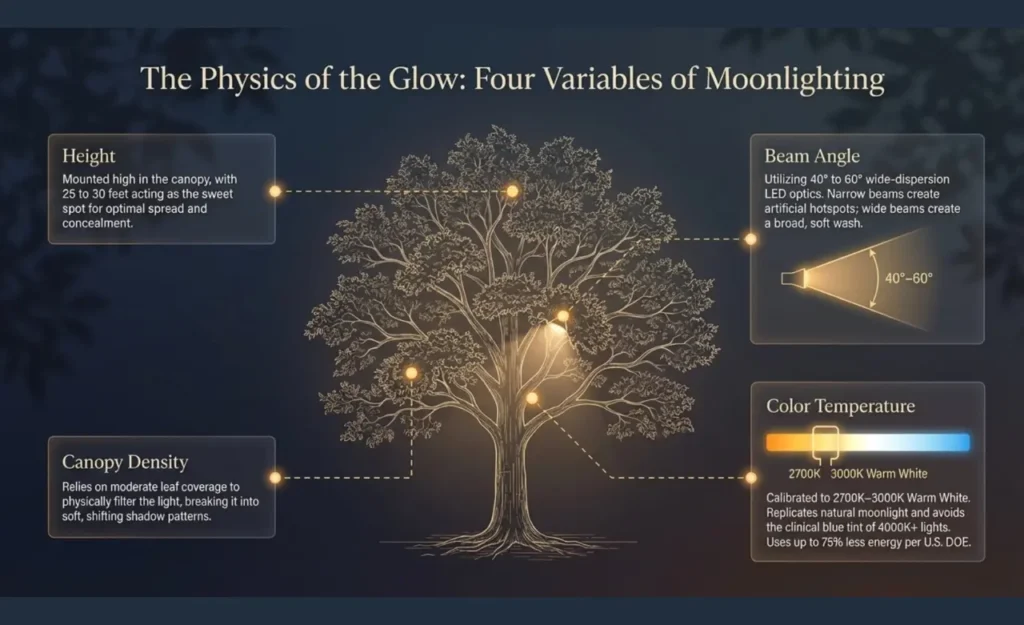
The moonlight effect lighting depends on four variables working together: fixture height, beam angle, color temperature, and the tree’s canopy density.
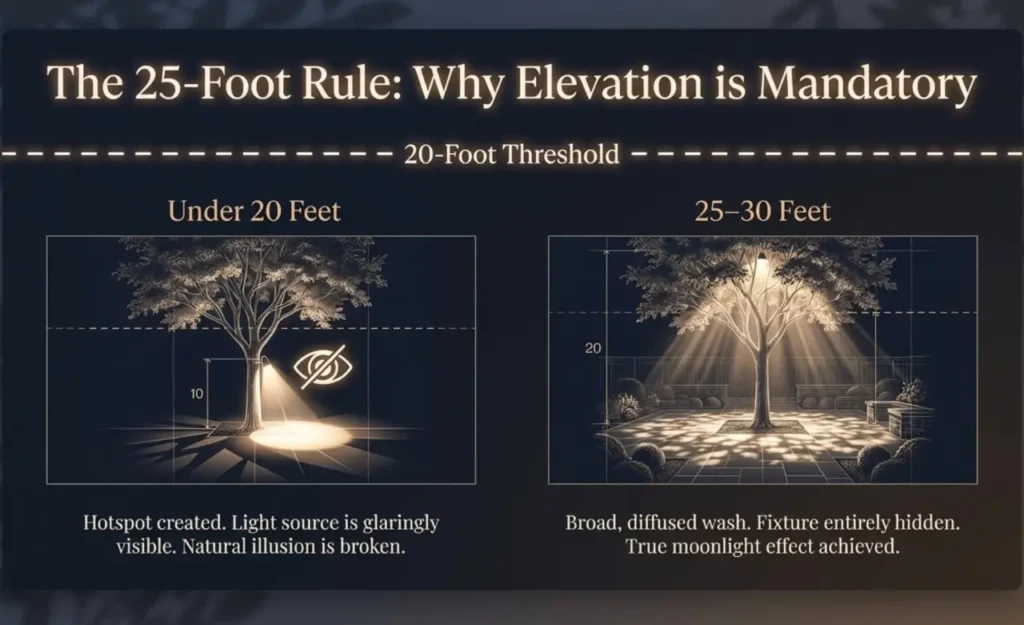
Height: Fixtures should be mounted at least 20 feet up, with 25 to 30 feet being the sweet spot. Below 20 feet, the light source becomes visible from ground level, which breaks the illusion. Higher mounting also allows the light to spread more naturally across a wider area.
Beam angle: Wide beams (40 to 60 degrees) produce the best results. Narrow beams create focused spots on the ground that look artificial. The goal is a broad, soft wash of light, not a concentrated pool.
Color temperature: Warm white LEDs in the 2700K to 3000K range replicate the warm tone of natural moonlight. Cooler temperatures (4000K+) create a bluish, clinical feel that contradicts the organic atmosphere moonlighting is designed to produce. As the U.S. Department of Energy notes, modern LED technology delivers excellent color rendering at warm temperatures while using up to 75% less energy than traditional bulbs.
Canopy density: The tree’s leaf coverage determines how much the light is filtered. Dense canopies produce more shadowing and softer light. Open or sparse canopies let more direct light through, which can look closer to standard downlighting. The ideal candidates have moderate density with enough branching to create interesting shadow patterns.
Best Trees for Moonlight Landscape Lighting in Orange County
Not every tree is a good candidate for the moonlighting technique. The species, maturity, and canopy structure all matter. Here are the trees we work with most often across Orange County properties.
Coast live oaks are the top choice. Their broad, spreading canopies with layered branching create beautiful dappled patterns on the ground. Mature specimens with canopies 30+ feet wide can illuminate an entire patio or seating area from a single tree.
Ficus trees (especially Ficus microcarpa) offer dense, full canopies that filter light beautifully. Their thick foliage produces softer, more diffused light than more open-canopy trees.
Jacarandas provide a unique seasonal element. When in full leaf, they create excellent moonlighting effects. During their spring bloom, the purple canopy adds a stunning color dimension to the filtered light below.
Eucalyptus trees work well for properties with a more natural, California-native aesthetic. Their open, airy canopies allow more direct light through, creating broader illumination with less shadowing.
Mature palms are less ideal for traditional moonlighting because they lack the branching structure needed to filter light. However, they can serve as mounting points for fixtures aimed at nearby ground areas, functioning more as elevated downlights than true moonlighting.
For more tree-specific placement guidance, visit our guide on the best way to light a tree.
Where Should Moonlights Be Placed?
Moonlight landscape lighting placement requires thinking about both the tree and the space below it. The goal is illuminating functional areas while preserving the natural, organic quality of the effect.
Over patios and seating areas: This is the most popular application. One or two fixtures high in a canopy above a dining table or lounge area provide enough ambient light for comfortable evening use without the harshness of overhead electric fixtures.
Along walkways: Trees lining a path or garden walk are natural mounting points. The filtered light illuminates the walking surface while creating an enchanting corridor effect that makes even a short walk feel special.
Over pool and spa areas: Moonlighting reflected off a pool surface produces a shimmering effect that standard pool lights cannot replicate. The combination of underwater lighting with overhead moonlighting creates layers of illumination that make the entire pool area feel resort-quality.
Along driveways: For properties with tree-lined drives, moonlighting from overhead canopies provides elegant driveway illumination that avoids ground-level glare while maintaining a sophisticated, estate-like entrance experience.
Our landscape lighting placement guide covers specific distances and angles for every fixture type, including detailed moonlighting positioning.
Uplighting vs. Moonlighting: What’s the Difference?
Both techniques involve trees, but they serve completely different purposes.
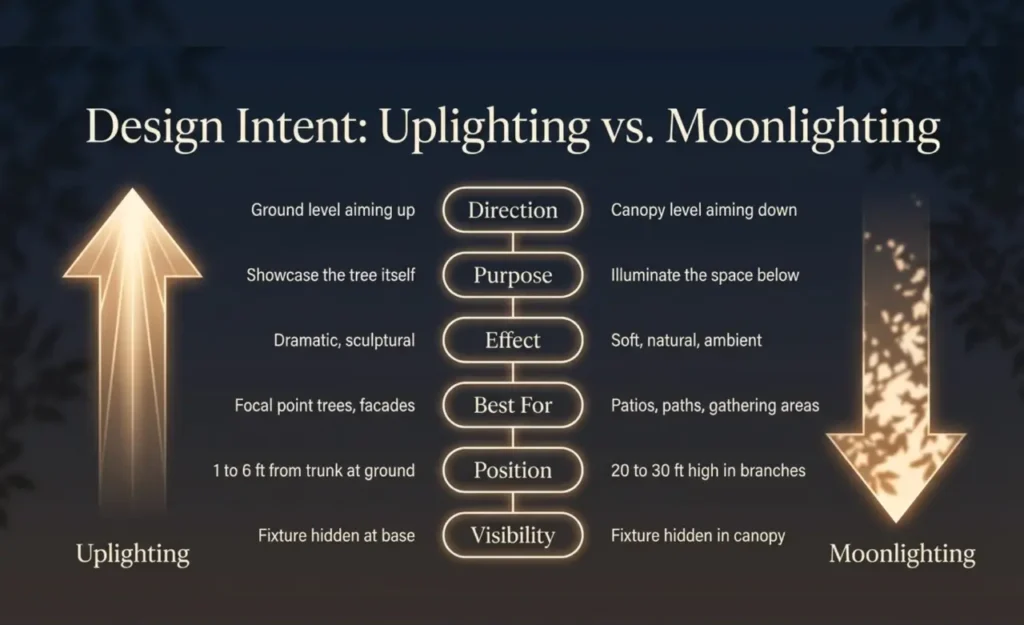
The most complete landscape lighting designs use both techniques together. Uplight the trunk and lower canopy to showcase the tree as a focal point. Moonlight from the upper canopy to illuminate the space beneath it. This combination creates depth that neither technique achieves alone.
Why Professional Moonlight Landscape Lighting Installation Matters
Moonlighting is one of the most technically demanding landscape lighting techniques. Working at heights of 20 to 30 feet requires specialized equipment, safety protocols, and the experience to select the right branch positions for both optimal lighting and long-term fixture stability.
Tree protection: Professional installers use non-invasive mounting brackets that strap around branches without penetrating bark. Drilling, nailing, or stapling into trees creates entry points for disease and pests that can compromise tree health over time. Wiring is routed along branches with protective clips rather than wrapped tightly around limbs.
Fixture durability: Fixtures mounted 25 feet in the air face direct exposure to wind, rain, UV radiation, and salt air in coastal Orange County. Commercial-grade solid brass construction withstands these conditions for 20+ years. Aluminum alternatives corrode and fail much faster, and replacing a fixture 25 feet up in a tree is significantly more involved than swapping one at ground level.
Concealed wiring: Running low-voltage wire from a ground-level transformer up a tree trunk and along branches without visible cables takes skill and planning. The wiring must be secured with non-damaging clips, routed behind the trunk’s visual profile, and connected with weatherproof junctions that can handle years of outdoor exposure.
As the U.S. Department of Energy recommends for outdoor lighting projects, professional installation ensures proper design standards, safe electrical connections, and efficient use of energy-saving LED technology.
Seasonal adjustment: Trees grow. New branches extend into light paths. Canopy density changes with seasons. Professional moonlighting installations include periodic re-aiming to maintain optimal performance as the tree matures. For our complete guide on keeping systems performing at their best, explore our landscape lighting tips.
Frequently Asked Questions About Moonlight Landscape Lighting
What is moonlight landscape lighting?
Moonlight landscape lighting is a technique where fixtures are mounted high in tree canopies (typically 20 to 30 feet) and aimed downward. The light filters through leaves and branches, creating soft, dappled patterns on the ground that mimic the look and feel of natural moonlight. It produces ambient illumination for outdoor living areas without any visible light source or harsh glare.
How does moonlighting work in landscape lighting?
A wide-beam LED fixture (40 to 60 degrees) is secured to a sturdy branch using non-invasive mounting hardware. The fixture is aimed downward at approximately 45 to 60 degrees from horizontal. As the light passes through the tree’s leaf canopy, it diffuses and scatters, producing the soft, natural glow characteristic of the moonlighting technique. Warm white LEDs (2700K to 3000K) replicate the warm tone of actual moonlight.
Where should moonlights be placed?
The best locations are above outdoor living areas where you spend time after dark: patios, dining spaces, seating areas, pool surrounds, and walkways. Mount fixtures on major branches that can support the weight long-term, positioned where the downward light will cover the functional area below. Avoid placing fixtures directly above reflective surfaces like glass tabletops, as this can create concentrated glare.
What is the difference between uplighting and moonlighting?
Uplighting shines from ground level upward to showcase the tree itself as a visual focal point. Moonlighting shines from the canopy downward to create ambient illumination in the space beneath the tree. Uplighting is dramatic and sculptural. Moonlighting is soft and natural. Professional designs often combine both on the same tree for a complete, layered effect.
Can moonlighting be installed on any tree?
Not every tree is a good candidate. The best trees for moonlighting are mature specimens at least 20 feet tall with moderate to full canopies and sturdy branching. Coast live oaks, ficus, jacarandas, and eucalyptus are excellent choices in Orange County. Dense evergreens may block too much light, and young trees lack the height and structural strength needed for safe fixture mounting.
Experience Moonlighting on Your Own Property
Moonlight landscape lighting is one of those techniques that photographs can hint at but never fully capture. The way shadows shift in the breeze, the warmth of the filtered glow, the sense that you’re sitting under a full moon on a perfect evening. It has to be experienced in person.
At Vision Outdoor Lighting, we design every moonlighting installation on-site after dark, testing fixture heights, angles, and positions with temporary setups before committing to final placement. Every project is owner-led, and every fixture is commercial-grade solid brass built to perform for 20+ years in Orange County’s coastal conditions.
Call today for professional lighting design: (949) 877-3600 or visit our contact page to schedule your consultation.
Explore our landscape lighting resources for more tips and ideas.