

Choosing the right types of landscape lighting can feel overwhelming. Between spotlights, path lights, well lights, downlights, and dozens of fixture variations, it’s easy to get lost in the options before you even start thinking about design.
But here’s what most guides won’t tell you: the fixture type is only part of the equation. The material it’s made from, the LED technology inside, and the way a designer combines multiple fixture types into a cohesive system are what separate a forgettable installation from one that transforms a property.
This guide breaks down every major type of landscape lighting fixture, explains where and how each one is used, and highlights the material and quality differences that matter most for Orange County homeowners. If you’ve been researching outdoor lighting tips or trying to build a landscape lighting plan, this is the foundation you need.
The 4 Main Types of Lighting in Landscape Design
Before diving into specific fixtures, it helps to understand the four main categories that every landscape lighting system draws from. These outdoor lighting types serve distinct purposes, and the best designs use all four in combination.
Ambient lighting provides overall illumination across a space. It’s the base layer that establishes general visibility in areas like patios, decks, and outdoor dining spaces. Without it, a property feels disconnected at night.
Task lighting focuses on functional needs. This includes step lights that prevent trips, pathway lighting that guides foot traffic, and brighter fixtures over outdoor kitchens or grilling areas where you need clear visibility to work safely.
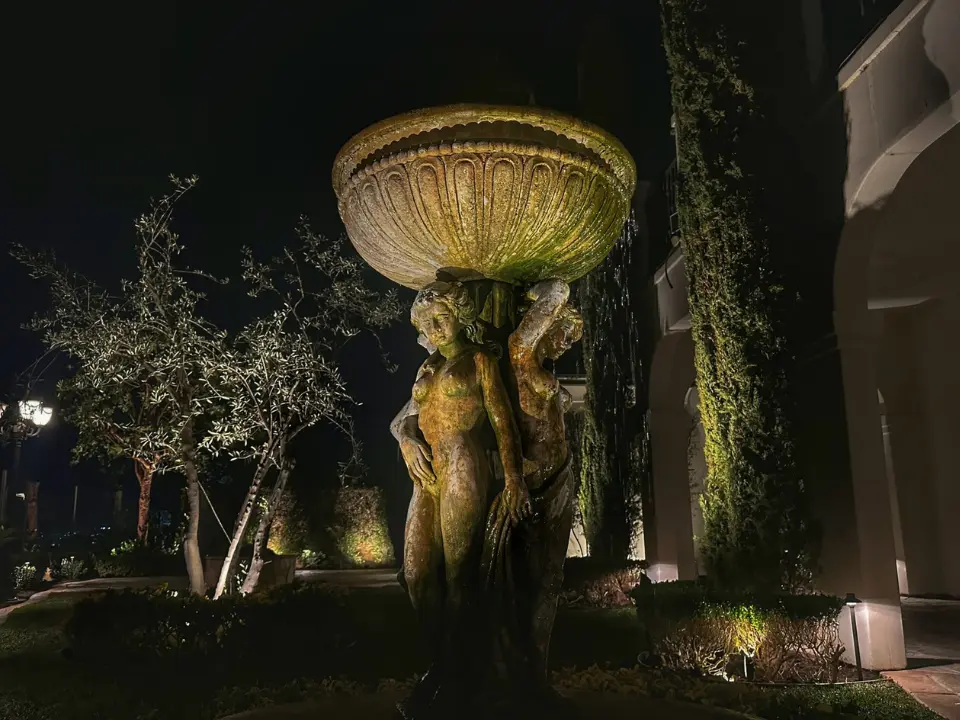
Accent lighting is where the drama lives. Spotlights aimed up into tree canopies, well lights grazing a stone wall, or underwater fixtures illuminating a pool all fall into this category. Accent lighting draws attention to specific features and creates the depth that makes a property feel alive at night.
Decorative lighting adds personality. String lights over a pergola, lantern-style fixtures at a garden entry, ornamental post lights along a driveway, or lighting around backyard decks serve both an aesthetic and atmospheric purpose. They’re meant to be seen and appreciated as part of the design.
Professional landscape lighting designers layer these four types together to create systems that are functional, safe, and visually compelling. A property that relies on only one type always feels incomplete. This applies not only to residential designs but also to larger projects, where understanding the types of commercial landscape lighting becomes important for achieving consistent results at scale.
Different Types of Landscape Lighting Fixtures Explained
Now let’s look at the specific landscape lighting fixtures you’ll encounter when building a system. Each type serves a particular function, and understanding these options will help you make informed decisions about your property.
Spotlights and Uplights
Spotlights (also called bullets or directional lights) are the most versatile landscape lighting fixtures in any system. They produce a focused, narrow beam that can be aimed at trees, architectural features, sculptures, or garden focal points.
When aimed upward from ground level, spotlights become uplights, and this is where they do their most impressive work. Tree uplighting, facade illumination, and feature highlighting all rely on spotlights positioned at the base of the element and angled toward the canopy or surface above.
Beam angles typically range from 10 degrees (narrow, focused beams for tall trees) to 60 degrees (wide floods for broad surfaces). In a path lights vs spotlights comparison, spotlights are the more flexible option because they can be repositioned and re-aimed as your landscape changes.
Material note: Spotlights spend their entire life exposed to soil, irrigation spray, and weather. In Orange County’s coastal climate, aluminum spotlight housings often show corrosion within two to three years. Commercial-grade solid brass resists this degradation and maintains structural integrity for 20+ years.
Downlights and Moonlights
Understanding uplights and downlights in landscape design means knowing when to reverse direction. Downlights are mounted in elevated positions, typically high in tree branches or under eaves, and cast light downward onto the area below.
Moonlighting is a specific downlighting technique where fixtures are placed 20 to 30 feet up in mature trees. The light filters through leaves and branches, creating soft, dappled patterns on the ground that mimic natural moonlight. This technique produces some of the most romantic and natural-feeling illumination in any landscape lighting plan.
Downlights also work well mounted under roof eaves to wash a facade or mounted beneath pergola beams to illuminate dining areas below.
Path Lights and Area Lights
Path lights are the most visible landscape lighting fixtures in a system because they stand above ground on posts typically 14 to 24 inches tall. They direct light downward and to the sides, illuminating walkways, garden borders, and driveways for safe navigation after dark.
Because path lights are always in view, fixture style matters here more than with any other type. The shape, finish, and design should complement your home’s architecture. A sleek modern fixture looks out of place on a Mediterranean estate, just as an ornate traditional fixture clashes with a contemporary build.
Area lights work similarly but cast a wider pool of illumination, making them suitable for lighting broader spaces like courtyards or landscape beds. As noted in the This Old House landscape lighting guide, spacing fixtures 15 to 20 feet apart creates pools of light that gently guide the eye without creating harsh continuous brightness.
Material note: Path lights take a beating from foot traffic, lawnmowers, and direct sun exposure. Brass path lights develop a natural patina over time that adds character to the landscape. Aluminum and plastic alternatives fade, crack, and corrode, often requiring replacement within three to five years.
Well Lights (In-Ground Lights)
Well lights sit flush with or slightly below ground level, directing their beam straight up. They’re ideal when you need to uplight a feature but want the fixture itself to remain completely invisible.
Common applications include uplighting architectural columns, illuminating the base of specimen trees, and creating wall-wash effects when placed along a foundation. Well lights also work in hardscape installations, recessed into pavers or concrete to create clean, seamless lines of light.
Because they’re buried in the ground, well lights face constant exposure to moisture, soil, and debris. A poorly installed well light will fill with water and fail. Professional installation includes proper drainage gravel beneath the housing and sealed connections to prevent moisture intrusion.
Hardscape and Step Lights
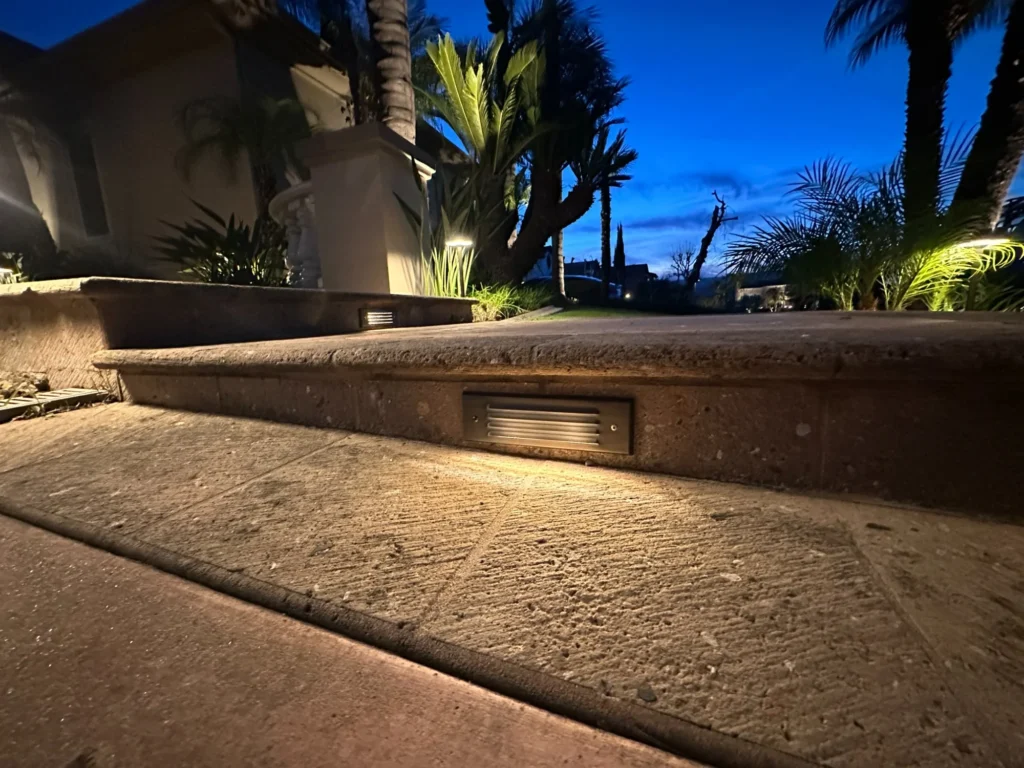
Hardscape lights mount directly to stone, brick, or concrete surfaces, typically under wall caps, seat walls, stair risers, or kitchen countertop overhangs. They cast a subtle wash of light across the surface below, adding both safety and ambient glow to outdoor living areas.
Step lights serve a similar function but are specifically designed for stairways. Mounted into the riser (the vertical face of each step) or into an adjacent wall, they illuminate the tread surface so you can see each step clearly without creating eye-level glare.
These are among the most underused types of outdoor lighting fixtures, but they make a significant difference in how outdoor living spaces feel and function after dark. A patio with hardscape lights under the seat walls feels warm and finished. The same patio without them feels flat and incomplete.
Flood Lights
Flood lights produce a wide, powerful beam designed to cover large areas for security purposes. In residential design, use them sparingly. A single flood light on a garage can light an entire driveway, but three or four will make the property look like a commercial parking lot. Let the accent and ambient layers do the heavy lifting while floods handle functional security needs.
String Lights and Bistro Lights
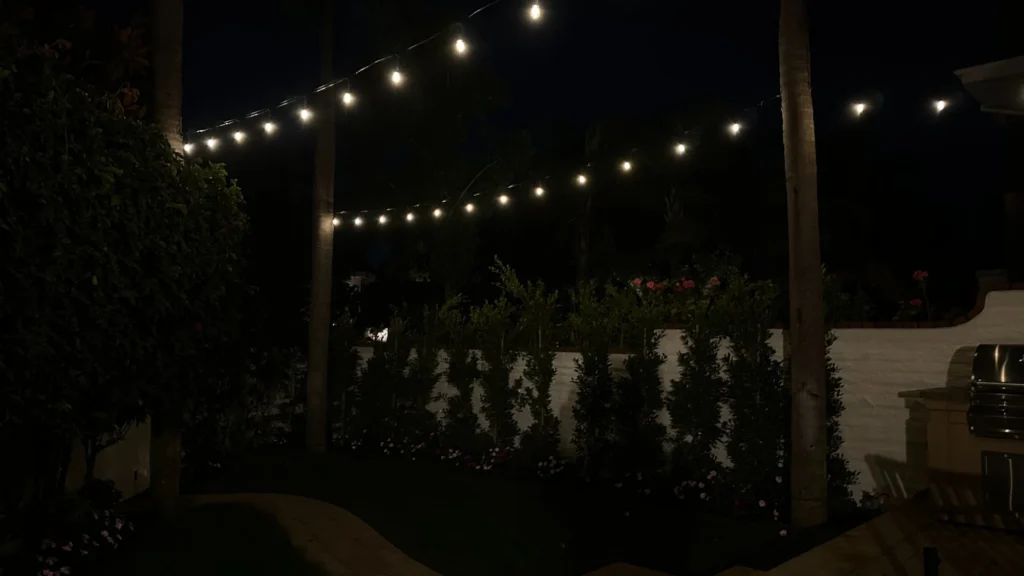
String lights (often called bistro or café lights) have become one of the most popular landscape lighting options for outdoor entertaining. Draped across pergolas, strung between trees, or hung along fence lines, they create a warm, festive atmosphere. For long-term installations, choose commercial-grade string lights with heavy-duty wiring and shatter-resistant LED bulbs. Consumer-grade options tend to sag, yellow, and fail within a season or two of outdoor exposure.
Types of Landscape Lighting Materials: Why It Matters
The fixture type only tells half the story. The material your landscape lighting fixtures are made from determines how long they’ll last, how they’ll look over time, and how they’ll handle Orange County’s coastal environment.
| Material | Lifespan | Corrosion Resistance | Best For |
| Solid Brass | 20+ years | Excellent (develops natural patina) | All fixture types, coastal properties |
| Copper | 20+ years | Excellent (develops verdigris patina) | Accent fixtures, traditional properties |
| Cast Aluminum | 3 to 7 years | Poor (corrodes in coastal/humid areas) | Budget installations, inland only |
| Plastic/Composite | 1 to 3 years | Very poor (UV degradation, cracking) | Temporary or seasonal use only |
| Stainless Steel | 10 to 15 years | Good (varies by grade) | Modern/contemporary designs |
For properties in Newport Beach, Dana Point, Laguna Niguel, and other coastal Orange County communities, salt air accelerates corrosion dramatically. This is why we exclusively use commercial-grade solid brass fixtures. The upfront cost is higher, but the 20+ year lifespan makes it the most cost-effective choice over time.
LED Landscape Lighting Types: Integrated vs. Lamp-Ready
Modern landscape lighting runs almost exclusively on LED technology. The two main categories are integrated LED fixtures and lamp-ready fixtures.
Integrated LED fixtures have the LED board built directly into the housing. They tend to be slimmer and more compact, which is helpful for tight installations. The downside: if the LED board fails, you replace the entire fixture.
Lamp-ready fixtures accept a standard LED bulb (typically MR16 or PAR36) that can be swapped out independently. This gives you flexibility to change brightness, beam angle, or color temperature without replacing the fixture itself. If a bulb fails after several years, a $15 replacement solves the problem.
For most residential applications, lamp-ready fixtures offer the best long-term value and flexibility. Quality LED bulbs in these fixtures typically last 50,000+ hours, which translates to roughly 15 to 20 years of nightly use.
The 4 C’s of Lighting: A Framework for Design Decisions
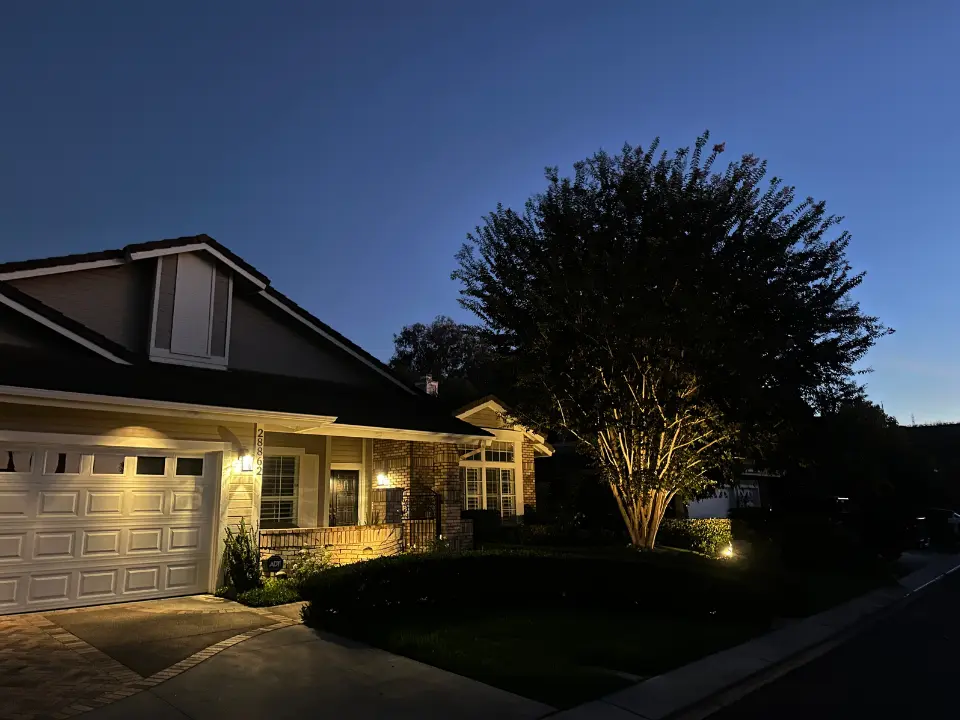
When evaluating different types of landscape lighting for your property, the 4 C’s of lighting provide a helpful framework: Contour, Contrast, Clarity, and Color.
Contour refers to how light defines the shape and form of objects. Uplighting a tree trunk creates contour by revealing its dimensional form against the night sky.
Contrast is the interplay between light and shadow. The best landscape lighting systems create deliberate contrast, not flat, even brightness. Dark areas between lit zones are essential to creating depth.
Clarity means the light is clean, well-defined, and free of glare. Shielded fixtures, proper aiming, and appropriate brightness levels all contribute to clarity.
Color in landscape lighting is primarily about color temperature. Warm whites (2700K to 3000K) create inviting, natural-looking illumination. Consistency across all fixtures in a system ensures visual harmony.
These four principles guide how professionals select and combine landscape lighting options to create systems that feel intentional, cohesive, and sophisticated.
How Professionals Combine Multiple Fixture Types
A common mistake homeowners make is buying one type of fixture and using it everywhere. A front yard lit entirely with path lights looks like an airport runway. A backyard with only spotlights feels harsh and one-dimensional.
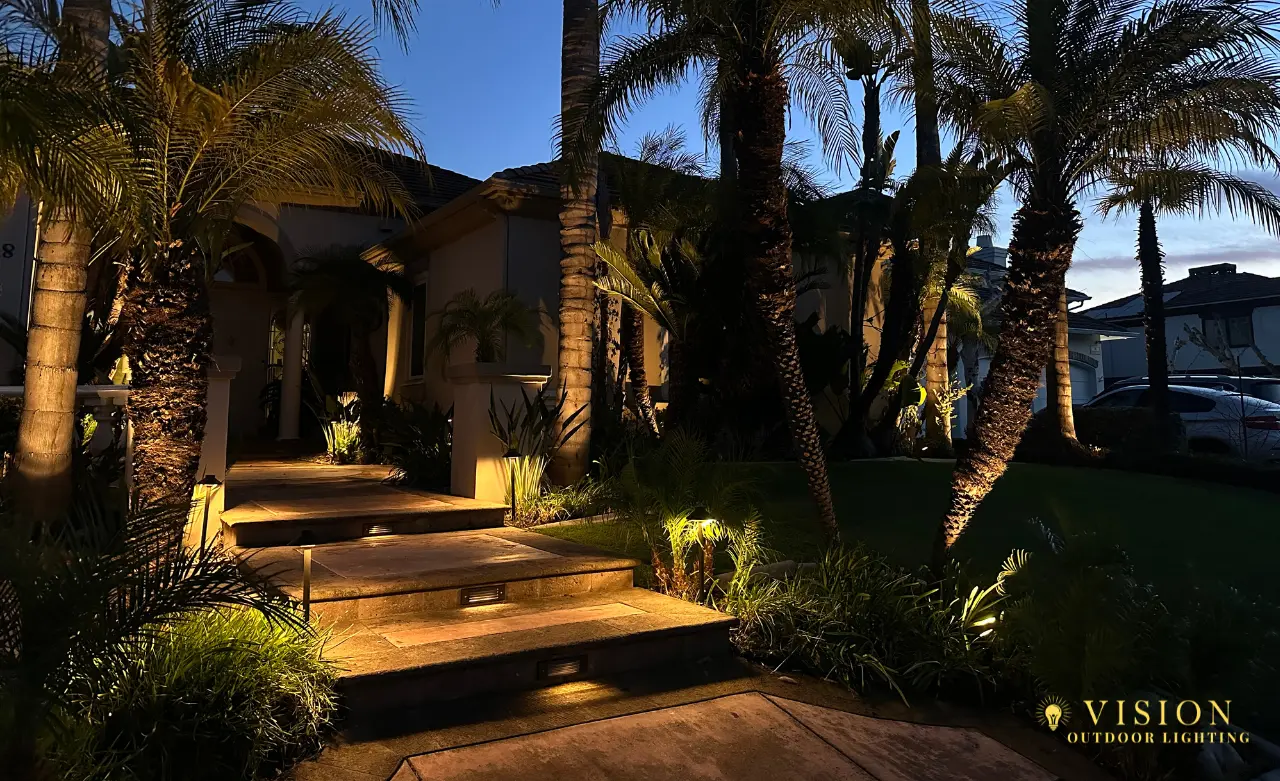
Professional outdoor lighting design combines multiple fixture types into a layered system. A typical front yard might include spotlights uplighting the facade and key trees, path lights along the walkway, well lights at column bases, and hardscape lights under the porch cap wall. Each fixture type handles a specific role, and together they create the depth that makes properties look stunning at night.
This is where having a landscape lighting plan matters. Walking your property at night, identifying what deserves emphasis, and mapping out which fixture types go where is the difference between a collection of lights and a cohesive lighting design.
Frequently Asked Questions About Types of Landscape Lighting
What are the different types of landscape lighting?
The main types include spotlights/uplights, downlights/moonlights, path lights, area lights, well lights (in-ground), hardscape lights, step lights, flood lights, and string lights. The most effective systems combine several types into a layered design that balances aesthetics, safety, and functionality.
What are the 4 main types of lighting?
The four main types of lighting in landscape and architectural design are ambient (general illumination), task (functional lighting for specific activities), accent (highlighting features and focal points), and decorative (fixtures that add visual personality to a space). A well-designed landscape lighting system uses all four types working together.
What are the 4 C’s of lighting?
The 4 C’s of lighting are Contour (how light reveals shape and form), Contrast (the interplay between illuminated areas and shadow), Clarity (clean, glare-free illumination), and Color (the warmth or coolness of light measured in Kelvins). These principles help designers evaluate how different fixture types and outdoor lighting placements will affect the overall look and feel of an outdoor space.
What are the styles of lighting used in landscape design?
Landscape lighting styles include uplighting (illuminating from below), downlighting/moonlighting (from above), wall grazing (angled along texture), wall washing (even light across a surface), silhouetting (backlighting to create dark outlines), shadowing (casting feature shadows onto walls), and cross-lighting (two-angle illumination for dimension). Professional designers select styles based on each area’s specific needs.
What types of landscape lighting materials last longest outdoors?
Solid brass and copper last longest, enduring 20+ years in all climates. Both develop a natural patina that adds character while protecting the fixture. Cast aluminum and plastic degrade much faster, especially in coastal areas like Orange County where salt air accelerates corrosion. For properties near the coast, brass is the recommended material for every fixture type.
What types of landscape lighting use LED technology?
Today, virtually all professional landscape lighting uses LED technology in two formats: integrated fixtures (LED built into the housing) and lamp-ready fixtures (replaceable LED bulb). Lamp-ready fixtures offer more flexibility and easier maintenance. Quality LED landscape lights operate at 2700K to 3000K and last 50,000+ hours, making them the most energy-efficient option for residential properties.
Find the Right Types of Landscape Lighting for Your Property
Understanding the different types of landscape lighting is the first step toward creating a system that transforms your property. But choosing the right combination of fixtures, materials, and techniques for your specific home takes expertise.
At Vision Outdoor Lighting, we personally design every system using commercial-grade solid brass fixtures and a layered approach that combines multiple fixture types into a cohesive, long-lasting design. Every project in Newport Beach, Irvine, Coto De Caza, and across Orange County is owner-led from consultation through installation.
Schedule Your Design Consultation by visiting our contact page or calling us directly at (949) 877-3600.
Explore our landscape lighting resources for more tips and ideas.