

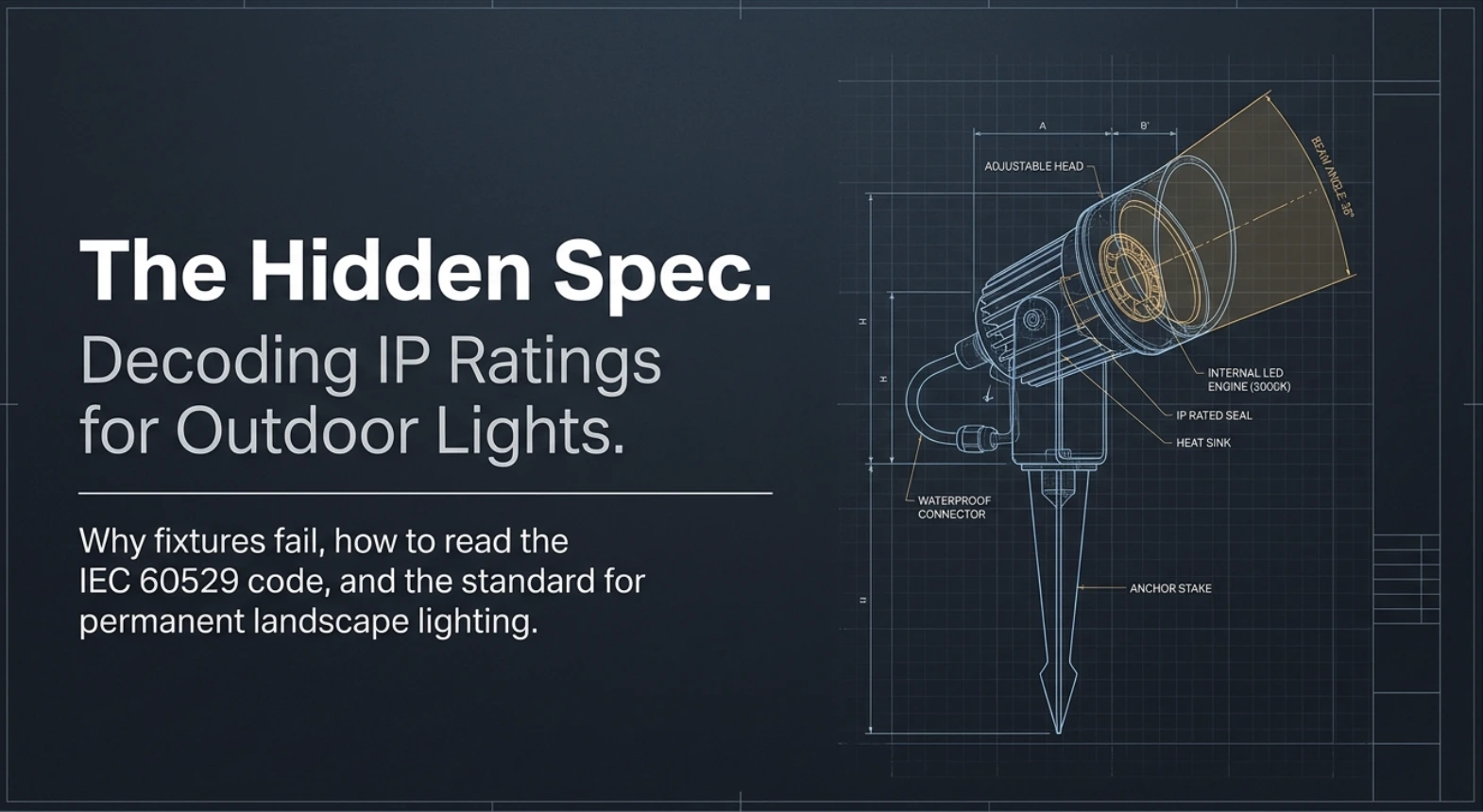
IP rating for outdoor lights tells you exactly how well a fixture resists dust and water. The rating uses two digits: the first (0 to 6) measures solid particle protection, the second (0 to 9) measures liquid protection. For landscape lighting, IP65 is the minimum for exposed fixtures, IP67 for in-ground applications, and IP68 for underwater or submersible installations. Fixtures below IP65 will fail prematurely in outdoor conditions, especially in Orange County where salt air, marine moisture, irrigation spray, and UV exposure are constant. Commercial-grade fixtures with legitimate IP ratings outlast consumer-grade products by years, and the IP rating is one of the fastest ways to separate the two.
Most homeowners never look at the IP rating when selecting landscape lighting. They compare lumens, color temperature, and price, then wonder why fixtures corrode, fill with condensation, or stop working within two years. The IP rating is the specification that predicts all of these failures before they happen.
This guide explains how the IP code system works, what each rating means in practice, and how to select the right ip rating for outdoor lights on your property. For broader fixture guidance, see our types of landscape lighting guide.
How the IP Code System Works
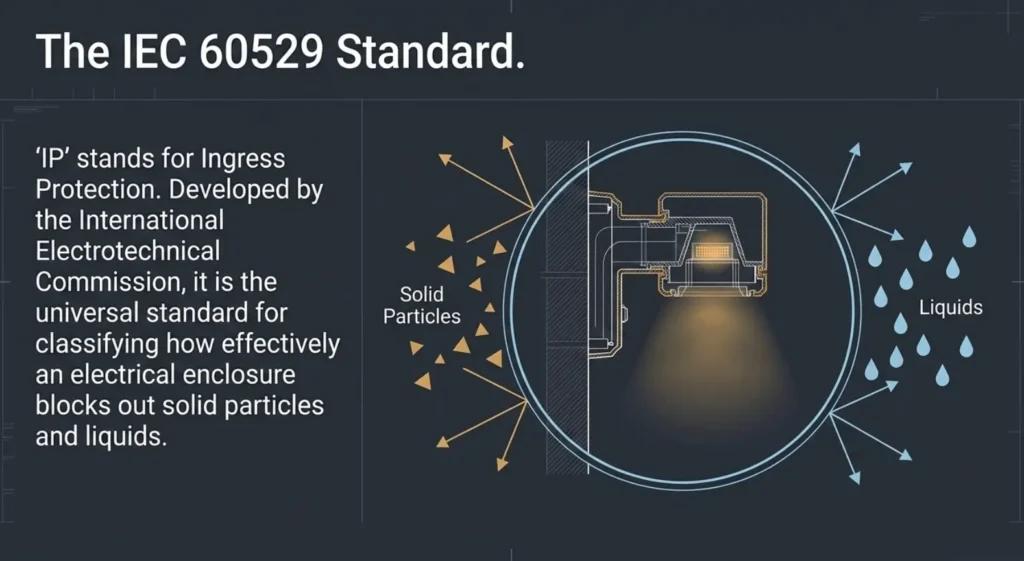
IP stands for Ingress Protection. The standard (IEC 60529) was developed by the International Electrotechnical Commission to classify how effectively an enclosure protects electrical equipment against solid particles and liquids. UL Solutions tests and certifies outdoor lighting fixtures against these IP standards as part of their safety and performance evaluation process.
Every IP rating outdoor lighting fixtures carry consists of two digits. The first digit rates protection against solids (dust, dirt, debris). The second rates protection against liquids (rain, sprinklers, submersion). Higher numbers mean greater protection.
First Digit: Solid Particle Protection
| Rating | Protection Level |
| 0 | No protection |
| 1 | Objects larger than 50mm (back of hand) |
| 2 | Objects larger than 12.5mm (finger) |
| 3 | Objects larger than 2.5mm (thick wire) |
| 4 | Objects larger than 1mm (thin wire) |
| 5 | Dust-protected (limited ingress, no harmful deposit) |
| 6 | Dust-tight (no ingress of dust) |
Second Digit: Liquid Protection
| Rating | Protection Level |
| 0 | No protection |
| 1 | Vertical dripping water |
| 2 | Dripping water at 15-degree tilt |
| 3 | Spraying water up to 60 degrees |
| 4 | Splashing water from any direction |
| 5 | Water jets from any direction |
| 6 | Powerful water jets from any direction |
| 7 | Temporary immersion (up to 1 meter, 30 minutes) |
| 8 | Continuous submersion (manufacturer specified) |
So an IP65 fixture is completely dust-tight (6) and protected against water jets from any direction (5). An IP68 fixture is dust-tight (6) and rated for continuous submersion (8). Understanding this two-digit system is the foundation for selecting the right ip rating for outdoor lights across every position on your property.
What IP Rating Do Outdoor Lights Need by Application
Different landscape lighting applications face different environmental exposure. A fixture mounted under an eave faces different conditions than one buried at ground level in a sprinkler zone.
| Application | Minimum IP | Why |
| Path lights | IP65 | Exposed to rain, sprinklers, kicked debris |
| Tree uplights / spotlights | IP65 | Ground-level, irrigation spray, soil splash |
| Wall-mounted fixtures | IP44 to IP65 | IP44 for covered locations, IP65 for exposed |
| In-ground well lights | IP67 | Buried at grade, standing water, soil pressure |
| Step / hardscape lights | IP65 to IP67 | Foot traffic, rain pooling, cleaning spray |
| Pool / underwater lights | IP68 | Continuous submersion, chemical exposure |
| Transformers | IP44 to IP65 | Sheltered mounting preferred, IP65 if exposed |
Vision Outdoor Lighting uses IP65 landscape lights as the minimum across all exposed fixture positions. In-ground applications get IP67 or higher. This is not overspecification. It is the standard that ensures weatherproof outdoor fixtures perform across Orange County’s year-round conditions.
IP65 vs IP67 vs IP68 and When Each Rating Matters
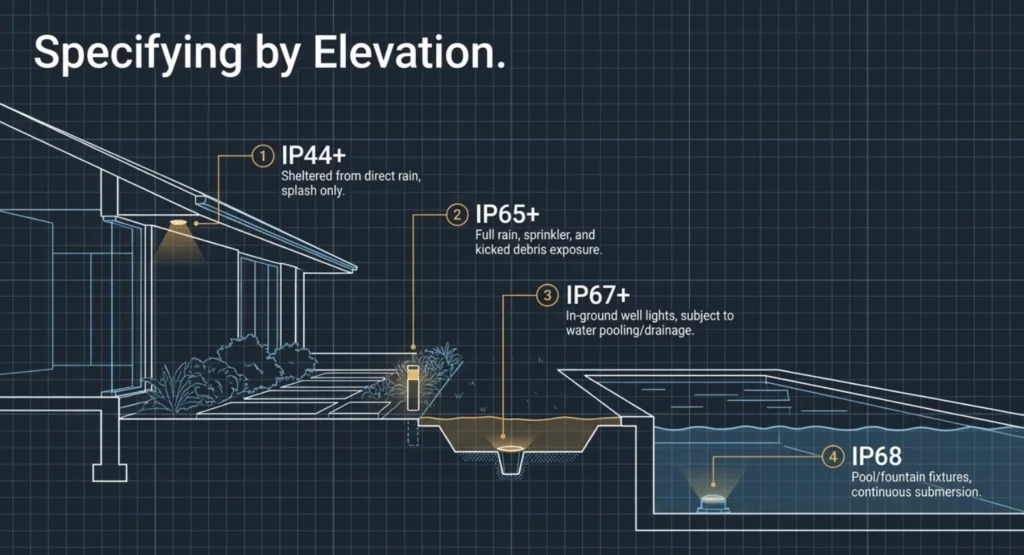
IP65: Dust-tight, water jet resistant. This is the baseline for all exposed landscape lighting. Rain, sprinkler overspray, garden hose splash, and wind-driven moisture are all within IP65 protection. Most path lights, spotlights, and accent fixtures should carry at least this rating. Are IP65 lights waterproof? They resist water from any direction, but they are not designed for submersion. A brief splash is fine. Standing water pooling around the fixture over time is not.
IP67: Dust-tight, temporary immersion resistant. This rating handles fixtures installed at ground level where water can pool during rain, irrigation, or drainage events. In-ground well lights and fixtures installed in low-lying landscape beds that collect runoff need IP67. The IP67 vs IP68 distinction matters: IP67 handles temporary flooding. IP68 handles continuous submersion.
IP68: Dust-tight, continuous submersion. Pool lights, fountain fixtures, and any application where the fixture operates while submerged require IP68. The manufacturer specifies the depth and duration. This is genuine waterproof landscape lighting for submersed applications.
Do Coastal Homes Need Higher IP Ratings
IP ratings measure protection against fresh water and dust. They do not specifically measure salt air corrosion, UV degradation, or chemical resistance. A fixture rated IP65 will prevent water and dust intrusion in Corona del Mar the same way it does in Irvine. The difference is what happens to the fixture materials themselves.
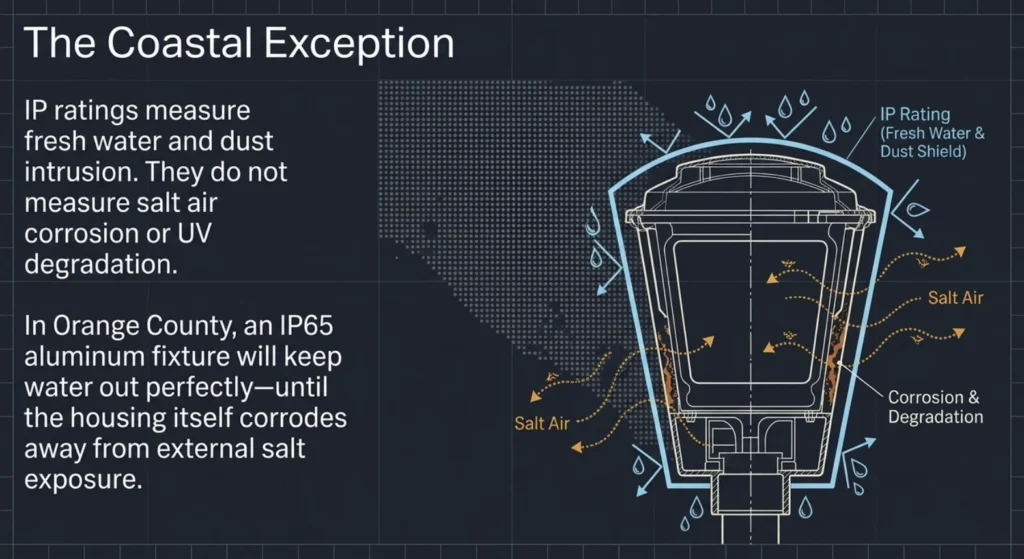
Salt air attacks the housing, hardware, and finish of every outdoor fixture. An IP65-rated aluminum fixture might keep water out for years, but the housing itself corrodes from external salt exposure long before the seal fails. This is why material selection matters as much as the IP rating for coastal Orange County properties.
Commercial-grade solid brass and copper resist salt air corrosion naturally. The material develops a protective patina over time rather than degrading. Paired with an IP65+ rating, brass fixtures deliver both ingress protection and material durability that aluminum and plastic cannot match in coastal environments. DarkSky International recommends using only as much light as needed. Fixtures that fail and get replaced with brighter, poorly aimed substitutes contribute to the light pollution and glare problems that responsible outdoor lighting avoids.
Why Cheap Fixtures Fail Even With Claimed IP Ratings
The ip rating for outdoor lights is only as reliable as the testing behind it. Consumer-grade fixtures from big-box retailers often claim IP65 ratings that were never independently verified. The fixture might pass the test at the factory, but after a few thermal cycles (hot days followed by cool nights), the seals contract and moisture finds its way in.
Gasket quality degrades over time. Cheap rubber gaskets harden, crack, and lose compression after a year or two of UV exposure. Commercial-grade fixtures use silicone or EPDM gaskets rated for outdoor temperature cycling and UV resistance.
Lens seals fail from thermal expansion. Plastic lenses expand and contract at different rates than metal housings. Over hundreds of thermal cycles, the seal gap widens and allows moisture intrusion. Glass lenses with properly engineered compression fittings maintain their seal indefinitely.
Wiring entry points are vulnerable. The point where wires enter the fixture housing is the most common failure point. Commercial-grade fixtures use compression glands that maintain seal integrity under movement. Consumer-grade fixtures often use simple rubber grommets that dry out and crack.
This is why two fixtures with identical IP65 ratings on the box can deliver completely different longevity in the field. The outdoor light protection rating printed on the packaging does not tell you about gasket material, lens quality, or wiring entry construction. Those details determine how long the rated protection actually holds.
How to Verify a Fixture Actually Meets Its Claimed IP Rating
Not every IP rating printed on a box has been independently tested. Legitimate manufacturers submit fixtures to accredited third-party labs (UL, ETL, CSA, TUV) that run standardized tests under controlled conditions. The test results are documented and the certification is traceable. Ask for the test report or at minimum confirm the fixture carries a recognized certification mark.
Look for third-party certification marks. UL, ETL, or CSA marks on the fixture indicate it was tested by an accredited lab. Self-declared IP ratings without third-party verification are common on imported consumer-grade products and carry no independent validation.
Check the documentation. Reputable manufacturers publish IP ratings in their specification sheets with test standard references (IEC 60529 or EN 60529). If the spec sheet lists lumens, color temperature, and wattage but skips the IP rating entirely, that fixture was probably not designed with ingress protection as a priority.
Compare the construction. Pick up the fixture. Quality IP65+ construction feels solid. Gaskets are visible and compressible. Lenses sit flush with no visible gaps. Wiring entries use compression glands, not simple rubber plugs. If the fixture feels hollow or the lens rattles, the IP rating is likely overstated regardless of what the packaging claims.
Vision Outdoor Lighting exclusively specifies fixtures from manufacturers who provide third-party verified IP ratings with traceable test documentation. This is a standard practice for commercial-grade products and a standard that consumer-grade imports rarely meet. For more on how fixture types affect system longevity, see our outdoor lighting placement guide.
Quick-Reference: IP Rating Selection for Landscape Lighting
| Fixture Location | Rating | Key Consideration |
| Under eave or soffit | IP44+ | Sheltered from direct rain, splash only |
| Open-air path or garden | IP65+ | Full rain, sprinkler, and debris exposure |
| Ground-level spotlight | IP65+ | Irrigation spray, mud splash, kicked debris |
| In-ground / well light | IP67+ | Water pooling, soil saturation, drainage |
| Pool or fountain | IP68 | Continuous submersion, chemical exposure |
| Coastal any position | IP65+ brass | Salt corrosion requires material + IP protection |
Get Fixtures With IP Ratings That Actually Hold Up
Selecting the right ip rating for outdoor lights is one decision within a system where material quality, gasket construction, lens engineering, and wiring entry design all determine how long the rated protection lasts in real conditions. A commercial-grade IP65 brass fixture with silicone gaskets and glass lenses will outperform a consumer-grade IP65 aluminum fixture with rubber seals and plastic lenses by years.
For commercial-grade landscape lighting with proper IP ratings in Newport Beach, Irvine, Laguna Niguel, or anywhere in Orange County, contact Vision Outdoor Lighting or call (949) 877-3600. Every project is owner-led, uses commercial-grade solid brass fixtures with verified IP65+ ratings, and includes complete system documentation.
Visit our landscape lighting design page to learn more about how Vision selects and specifies fixtures for long-term performance.