

How bright should outdoor lights be depends entirely on the application. Path lights need 100 to 200 lumens. Tree uplights range from 200 to 1,200 lumens depending on tree size. Facade washes need 700 to 1,500+ lumens. Step lights need just 12 to 50 lumens. The most common mistake is overlighting, which flattens depth, creates glare, and makes a property look like a commercial parking lot instead of a home. Professional landscape lighting uses the minimum lumens needed for each application and relies on beam angle and fixture placement to do the rest. More lumens does not mean better lighting.
Brightness is the landscape lighting question homeowners get wrong most often. The instinct is to go brighter. Brighter path lights. Brighter uplights. Brighter everything. The result is a flat, washed-out yard where every surface is equally lit and nothing stands out.
This guide covers how many lumens outdoor lights actually need for each application, why less is almost always more, and how to select the right landscape lighting brightness for your property. For broader design guidance, see our outdoor lighting tips guide.
Lumens vs Watts and Why Lumens Are the Only Number That Matters
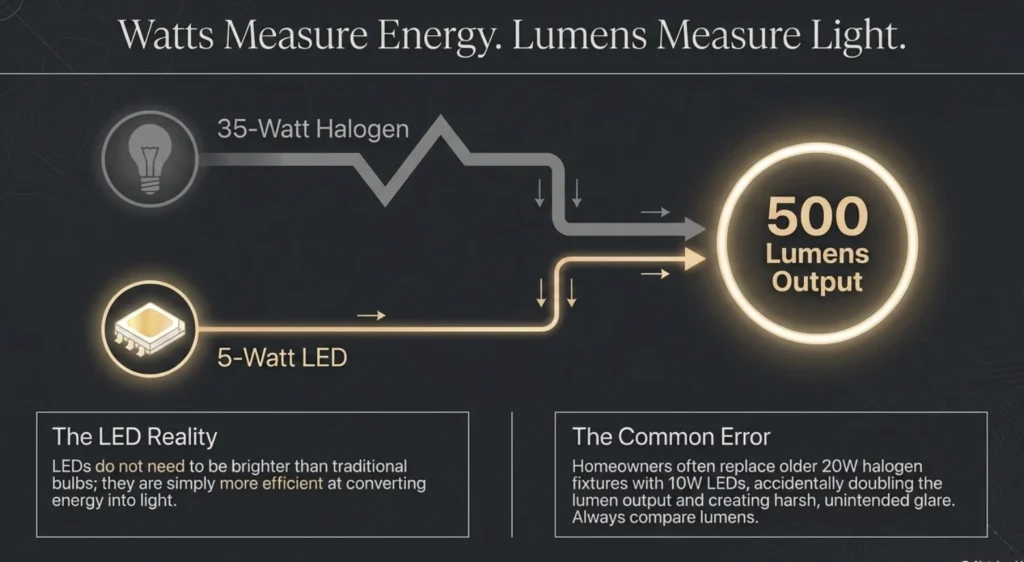
Watts measure energy consumption. Lumens measure light output. A 5-watt LED can produce the same outdoor lighting lumens as a 35-watt halogen. Comparing watts across LED and traditional fixtures is meaningless. Always compare lumens.
Do LED outdoor lights need to be brighter than traditional bulbs? No. LEDs produce more lumens per watt than halogen or incandescent, which means a lower-wattage LED typically matches or exceeds the brightness of a higher-wattage traditional fixture. A 5W LED spotlight producing 500 lumens replaces a 35W halogen at the same output. The LED is not dimmer. It is more efficient at converting energy into light.
This efficiency is why LED outdoor lighting brightness can actually be a problem. Homeowners replace 20W halogen path lights with 10W LEDs that produce twice the lumens, then wonder why the yard looks harsh. The LED is doing its job. It was just the wrong lumen level for the application.
Recommended Lumens by Landscape Lighting Application
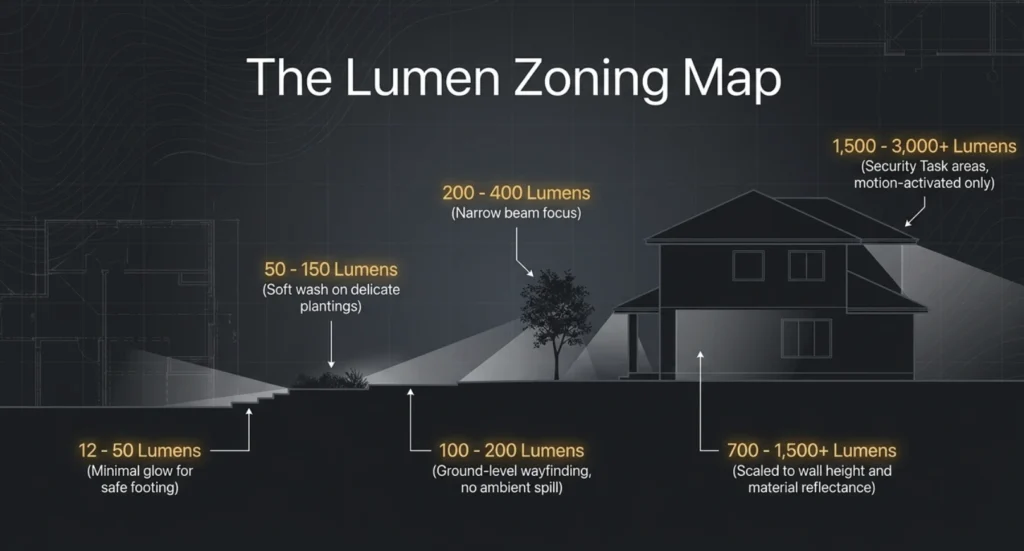
How bright should outdoor lights be varies dramatically by application. A step light and a facade wash serve completely different purposes and need completely different lumen levels.
| Application | Lumens | Notes |
| Path lights | 100 to 200 | Enough to see the path, not light the whole yard |
| Step / deck lights | 12 to 50 | Minimal glow for safe footing, nothing more |
| Tree uplight (small) | 200 to 400 | Trees under 15 feet, narrow beam |
| Tree uplight (large) | 500 to 1,200 | Trees 20 to 40+ feet, wider beam, multiple fixtures |
| Facade wash | 700 to 1,500+ | Depends on wall height, material reflectance |
| Architectural accent | 200 to 500 | Columns, arches, texture highlights |
| Moonlighting (down) | 200 to 500 | Soft, filtered through canopy |
| Garden / bed accent | 50 to 150 | Soft wash on low plantings |
| Security / flood | 1,500 to 3,000+ | Perimeter, motion-activated, task areas |
The table shows why a single lumen level across all fixtures creates problems. Path light lumens at 100 to 200 are correct for walkways but would barely register as a tree uplight. Conversely, using uplight brightness levels on a path creates blinding glare at ground level.
Why More Lumens Does Not Mean Better Landscape Lighting
The single biggest mistake in residential landscape lighting brightness is overlighting. Homeowners assume brighter is better, and the result is a yard that looks like it is being interrogated.
Overlighting eliminates depth. Professional landscape lighting creates visual interest through contrast. Lit areas draw the eye. Shadows create depth and dimension. When everything is equally bright, there is no contrast, no depth, and no visual hierarchy. The property looks flat.
Overlighting creates glare. Fixtures that are too bright for their application create glare that makes it harder to see, not easier. A 500-lumen path light aimed upward blinds anyone walking past. A 200-lumen fixture aimed downward at a 30-degree spread guides their feet comfortably.
Overlighting wastes energy. Every unnecessary lumen costs electricity. Across a 20-fixture system running 6 hours per night, the difference between appropriate and excessive brightness adds up over years.
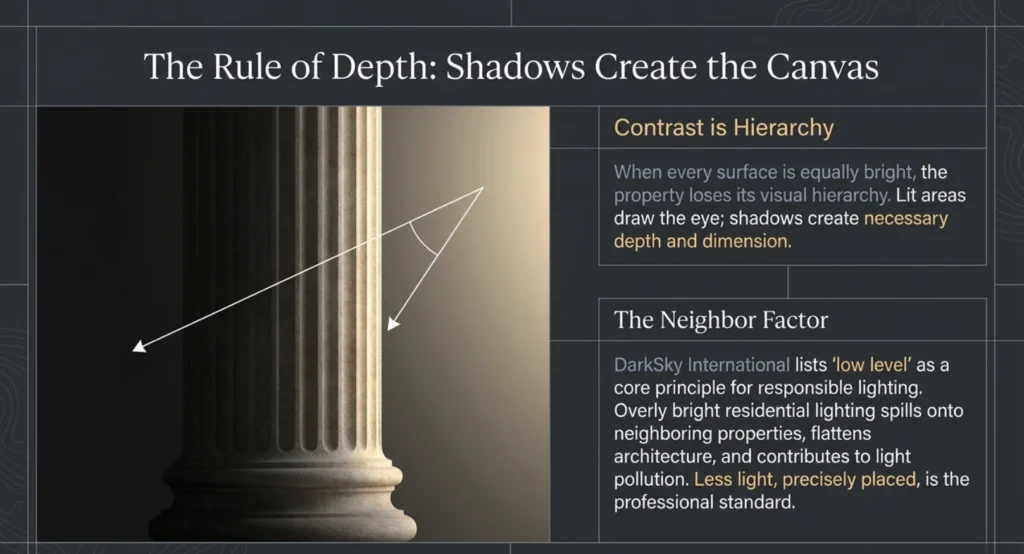
Overlighting disturbs neighbors. DarkSky International lists “low level” as one of its Five Principles for Responsible Outdoor Lighting, stating that light should be no brighter than necessary. Overly bright residential lighting spills onto neighboring properties and contributes to light pollution that affects wildlife and sky visibility.
How Beam Angle Affects Perceived Brightness
Two fixtures with identical lumens look completely different depending on beam angle. A narrow 10-degree beam concentrates all the light into a tight column. A wide 60-degree beam spreads the same lumens across a much larger area.
Narrow beams (10 to 25 degrees) create intense, focused light. Use these for architectural accent lighting, uplighting tall trees where you want a column of light up the trunk, and highlighting specific features. The same lumens in a narrow beam appear brighter because the light is concentrated.
Medium beams (25 to 40 degrees) handle most uplighting and accent work. These hit the balance between concentration and coverage that most residential landscape applications need.
Wide beams (40 to 120 degrees) spread light across broader surfaces. Use these for wall washes, facade lighting, and area illumination. The same lumens in a wide beam appear softer and less intense because the light distributes over a larger surface.
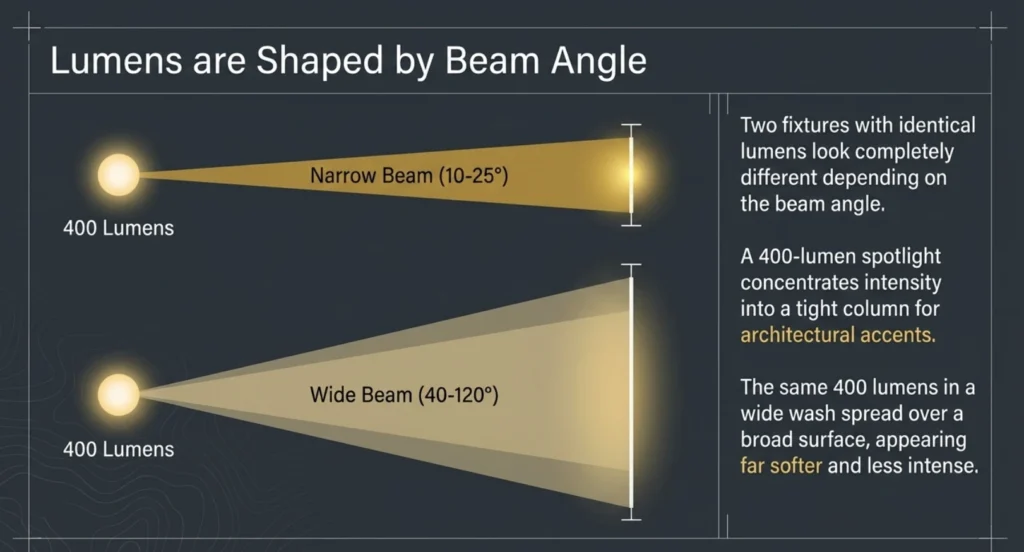
This is why how bright should outdoor lights be cannot be answered with lumens alone. A 400-lumen spotlight with a 15-degree beam looks far brighter than a 400-lumen wall wash with a 90-degree beam. Fixture selection, beam angle, and placement distance all work together to determine what a homeowner actually sees. For fixture-specific placement guidance, see our outdoor lighting placement guide.
How Distance Changes Brightness on Target
Light intensity decreases with distance according to the inverse square law. Doubling the distance between a fixture and its target reduces the light hitting that surface to one-quarter. This matters because most outdoor lighting lumens specifications describe output at the fixture, not at the target.
A 500-lumen uplight placed 2 feet from a tree trunk delivers far more light to the bark than the same fixture placed 8 feet away. Moving the fixture further back requires more lumens to achieve the same brightness on target. This is why professional designers specify fixture position and lumen output together, not independently.
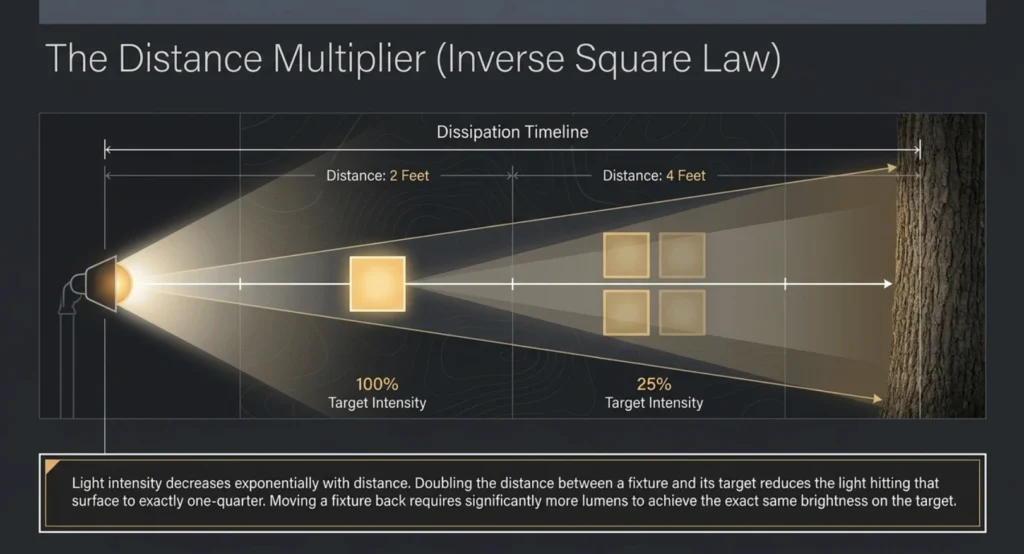
For large trees, this often means multiple lower-lumen fixtures positioned at different distances rather than a single high-lumen fixture blasting from one angle. The multi-fixture approach creates depth and dimension. The single-fixture approach creates a bright spot and a lot of shadow.
For Orange County properties specifically, mature trees in established neighborhoods across Newport Beach, Laguna Niguel, and Irvine often reach 30 to 40+ feet. Two or three 400-lumen fixtures positioned at different angles around the base produce a far more natural result than a single 1,200-lumen fixture aimed straight up. The total lumen output may be similar, but the distributed approach wraps light around the canopy instead of punching through it from one direction.
Fixture Quality Affects How Efficiently Lumens Reach the Target
Not all lumens are created equal. Two fixtures rated at 500 lumens can deliver very different amounts of usable light depending on optics, reflector design, and lens quality. The Illuminating Engineering Society emphasizes that delivered lumens (the light that actually reaches the target) matter more than rated lumens (the total output of the LED chip).
Commercial-grade fixtures use precision optics that direct a higher percentage of generated lumens toward the target. Consumer-grade fixtures lose more light to scatter, internal absorption, and poorly designed reflectors. A commercial-grade 300-lumen fixture with precision optics can deliver more usable light than a consumer-grade 500-lumen fixture with a cheap reflector.
This is one reason professional installations look more refined than DIY systems at the same or lower lumen levels. The fixtures are more efficient at putting light exactly where it needs to go, which means less total output produces a better visual result.
Brightness Should Be Adjustable, Not Fixed
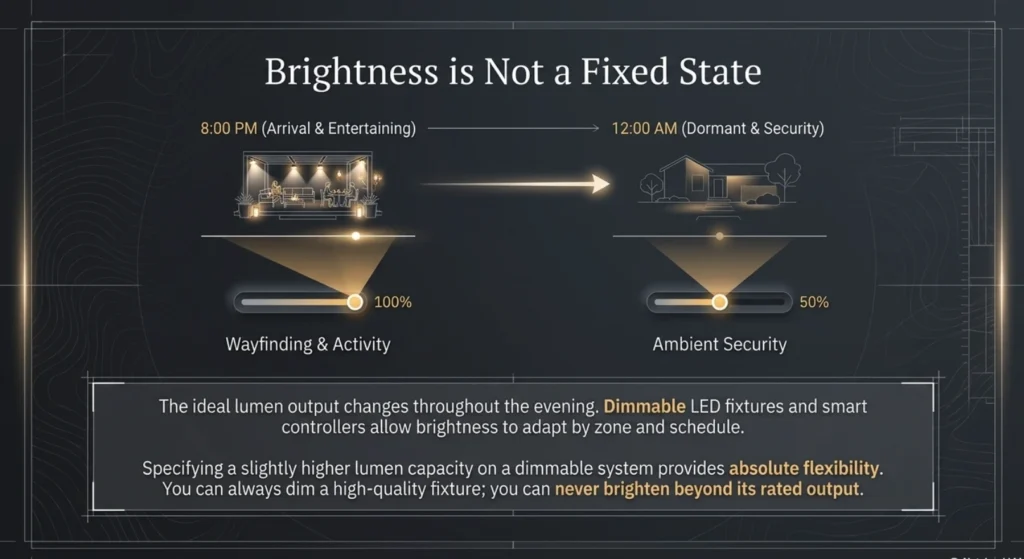
The best answer to how bright should outdoor lights be often changes throughout the evening. A patio that needs full brightness during a dinner party benefits from dimmed lighting after guests leave. Pathway lighting at full output during arrival hours can drop to 50% after midnight when the goal shifts from wayfinding to ambient security.
Dimmable LED fixtures and smart controllers let homeowners adjust landscape lighting brightness by zone and by schedule. This flexibility means the initial lumen selection does not have to be perfect. Slightly over-specifying lumens on a dimmable system is smarter than under-specifying on a fixed system. You can always dim down. You cannot brighten beyond a fixture’s rated output.
Quick-Reference: Landscape Lighting Brightness by Application
| Application | Lumen Range | Common Mistake |
| Path lights | 100 to 200 lumens | Using 400+ lumens, creating glare pools |
| Step lights | 12 to 50 lumens | Too bright, blinding when looking down steps |
| Small tree uplights | 200 to 400 lumens | One bright fixture instead of two moderate ones |
| Large tree uplights | 500 to 1,200 lumens | Single fixture, hot spot with no dimension |
| Facade wash | 700 to 1,500+ lumens | Too close to wall, uneven bright/dark bands |
| Garden accents | 50 to 150 lumens | Overpowering delicate plantings |
| Security flood | 1,500 to 3,000+ lumens | On all night instead of motion-activated |
Get Professionally Balanced Brightness for Your Property
Selecting how bright should outdoor lights be is one decision within a system where fixture type, beam angle, placement distance, color temperature, and control strategy all interact. Getting the brightness right but the beam angle wrong still produces a mediocre result. Professional designers balance all of these variables simultaneously, which is why a well-designed 15-fixture system outperforms a 30-fixture DIY installation that uses twice the lumens.
For professionally balanced landscape lighting in Newport Beach, Laguna Niguel, Coto de Caza, or anywhere in Orange County, contact Vision Outdoor Lighting or call (949) 877-3600. Every project is owner-led, uses commercial-grade solid brass fixtures, and includes complete system documentation.
Visit our landscape lighting design page to learn more about how Vision approaches whole-property systems with restraint and precision.