

Color temperature for outdoor lighting is measured in Kelvin (K) and determines how warm or cool your fixtures appear after dark. For residential landscape lighting, 2700K to 3000K is the professional standard. This range produces a warm, natural glow that complements foliage, stone, stucco, and wood without the harsh, institutional look of cooler temperatures. Cooler whites (4000K and above) are appropriate for commercial security and task lighting but look out of place on residential properties. Consistency across all fixtures matters more than most homeowners realize. Mixing color temperatures creates a disjointed appearance that makes even expensive fixtures look cheap.
Color temperature is one of the most visible decisions in any landscape lighting project, yet most homeowners make it based on whatever the fixture ships with. The result is often a yard lit by a mix of warm yellows, cool whites, and everything in between. It looks scattered, and no amount of fixture repositioning can fix a color temperature mismatch.

This guide explains how the Kelvin scale works, what each temperature range looks like outdoors, and how to select the right color temperature for outdoor lighting on your property. For broader design guidance, see our outdoor lighting tips guide.
What the Kelvin Scale Means for Outdoor Lighting
Kelvin (K) is the unit of measure for light color appearance. It has nothing to do with brightness. A 2700K fixture and a 5000K fixture can produce the same number of lumens (brightness), but they look completely different.
The scale works in the opposite direction from what most people expect. Lower Kelvin numbers produce warmer, amber-toned light. Higher numbers produce cooler, bluer light. Think of it this way: a candle flame is roughly 1800K (very warm). A clear midday sky is roughly 6500K (very cool, almost blue-white). Most outdoor lighting Kelvin selections fall somewhere in between.
| Kelvin Range | Light Appearance | Typical Outdoor Use |
| 2200K | Very warm amber | Ambient path accents, fire-pit areas |
| 2700K | Warm white | Residential landscape lighting (preferred) |
| 3000K | Soft white | Residential landscape lighting (also common) |
| 3500K | Neutral white | Transitional, some commercial |
| 4000K | Cool white | Commercial, parking, security |
| 5000K+ | Daylight / blue-white | Industrial, stadium, security |
The table above shows why outdoor lighting Kelvin selection matters. Moving from 2700K to 4000K changes the entire character of a property at night.
2700K vs 3000K Outdoor Lighting and Which to Choose
The 2700K vs 3000K outdoor lighting debate is the most common question homeowners ask, and the good news is that both work well for residential landscape lighting. The difference is subtle but real.
2700K produces a slightly warmer, more amber tone. It closely matches the warmth of a traditional incandescent bulb. The foliage looks lush and green. Stucco, stone, and wood take on a warm, inviting glow. It creates the most relaxed, intimate atmosphere and is the best kelvin for outdoor lights when the goal is ambiance and curb appeal.
3000K is marginally brighter and slightly less amber. It still falls firmly in the warm white range but adds a touch more clarity. Architectural details, textures, and hard edges show slightly more definition. Some homeowners prefer 3000K for facade uplighting and path lights where they want warmth with a bit more visual crispness.

Vision Outdoor Lighting uses 2700K to 3000K exclusively for residential landscape projects across Orange County. Both temperatures complement the Mediterranean, Spanish, Craftsman, and contemporary architecture common throughout the region. The most important decision is not which of the two to pick. It is picking one and using it consistently across every fixture on the property.
Why Warm White Outperforms Cool White in Residential Landscapes
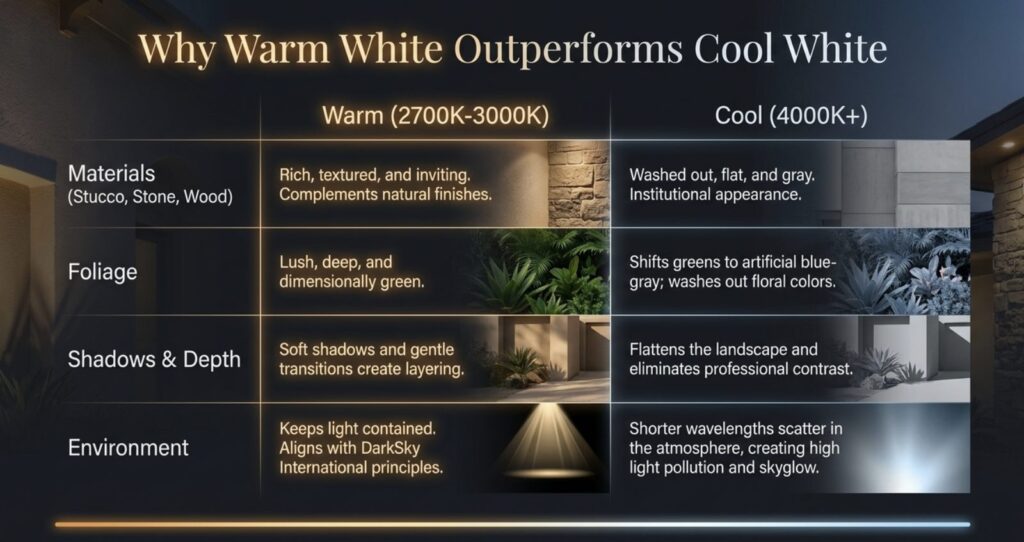
The warm white vs cool white outdoor lighting choice is not a matter of personal preference for residential properties. It is a design principle backed by both lighting professionals and environmental science.
Warm tones complement natural materials. Stucco, brick, natural stone, wood, and tile all look their best under warm light. Cool white (4000K+) washes out these textures and makes them appear flat and gray. This is why hospitals and parking garages use cool white. It emphasizes cleanliness and visibility, not beauty.
Warm tones enhance landscape color. Green foliage appears richer and more dimensional under 2700K to 3000K light. Cool white shifts green tones toward blue-gray, making healthy landscaping look washed out. Flowers lose their natural color under cooler temperatures. For homeowners who invest in professional landscaping, the LED color temperature landscape lighting uses preserves that investment after dark. The wrong temperature destroys it.
Warm tones reduce light pollution. DarkSky International lists warm-colored lighting as one of its Five Principles for Responsible Outdoor Lighting. Shorter wavelength (cooler, bluer) light scatters more in the atmosphere, contributing more to skyglow and disrupting wildlife. Warm white keeps light where it belongs while being a better neighbor to the surrounding environment.
Warm tones create depth and shadow. Professional landscape lighting relies on contrast between light and shadow to create visual interest. Warm temperatures produce softer shadows and gentler transitions that make properties look layered and dimensional. Cool white flattens everything and eliminates the depth that gives professional lighting its impact.
When Cooler Color Temperatures Are Appropriate
Cool white has legitimate applications outside residential landscape lighting. Understanding when it works helps homeowners recognize why it does not work on their property.
Commercial security lighting (4000K to 5000K). Parking lots, loading docks, and commercial perimeters benefit from cooler temperatures that maximize visibility and make security camera footage clearer. The goal is surveillance quality, not ambiance.
Task lighting (3500K to 4000K). Outdoor work areas, workshop spaces, and utility zones need clarity. A slightly cooler temperature helps with visibility on detailed tasks.
Accent lighting for specific effects. In rare cases, a cooler accent (3500K) can highlight a water feature or modern sculpture where the blue-white tone creates an intentional contrast. This should be deliberate and limited, not the default.
If every fixture on a residential property is 4000K or above, the system was planned for security rather than aesthetics or was not planned at all. For more on fixture types and applications, see our guide on the types of landscape lighting.
Why Color Temperature Consistency Matters More Than Most Homeowners Realize

Mixing color temperatures across a single property is one of the most common and most visible mistakes in residential landscape lighting. Path lights at 3000K next to tree uplights at 4000K next to string lights at 2200K creates a patchwork that no fixture quality can disguise.
Pick one temperature and use it everywhere. For a whole-property system, 2700K or 3000K across every fixture produces a cohesive, professional result. Path lights, uplights, downlights, step lights, wall washes, and string lights should all match.
Fixture quality affects consistency. Cheaper LED fixtures often ship with inconsistent color temperatures, even within the same product line. One fixture labeled 2700K might output 2600K while another reads 2900K. Over a dozen fixtures, the variation becomes visible. Commercial-grade fixtures hold tighter tolerances (typically within 100K of the rated temperature), which is why the color temperature for outdoor lighting on professional installations looks noticeably more uniform than DIY systems.
Dimming can shift color. Some LED fixtures shift slightly warmer when dimmed (called warm-dim). High-quality fixtures maintain their rated color temperature across the full dimming range. This is a detail that separates commercial-grade from consumer-grade products and directly affects how a system looks at different brightness levels throughout the evening.
Does Color Temperature Affect Outdoor Lighting Performance
Color temperature does not directly affect brightness, beam spread, or fixture lifespan. A 2700K fixture and a 5000K fixture with identical wattage and optics produce the same lumen output and project light the same distance. The difference is entirely in how the light appears and how it interacts with the materials it illuminates.
That said, color temperature does affect perceived brightness. Cool white light appears brighter to the human eye than warm white at the same lumen output because the eye is more sensitive to shorter wavelengths. This is why a 4000K path light seems brighter than a 2700K path light even when both produce identical lumens. For residential landscape lighting, this perceived brightness difference is actually a disadvantage. Overly bright-looking fixtures create glare, reduce the sense of depth, and make the system feel harsh rather than inviting.
Professional designers select color temperature for outdoor lighting based on how the property should feel at night, not on raw brightness metrics. The right lumen output paired with the right color temperature produces a result that looks natural and intentional rather than overlit and artificial.
Color Rendering Index and How It Relates to Color Temperature
Color Rendering Index (CRI) measures how accurately a light source renders colors compared to natural light. It runs on a scale from 0 to 100, where 100 is perfect. The Illuminating Engineering Society publishes standards for lighting quality that include both color temperature and CRI recommendations for residential applications.
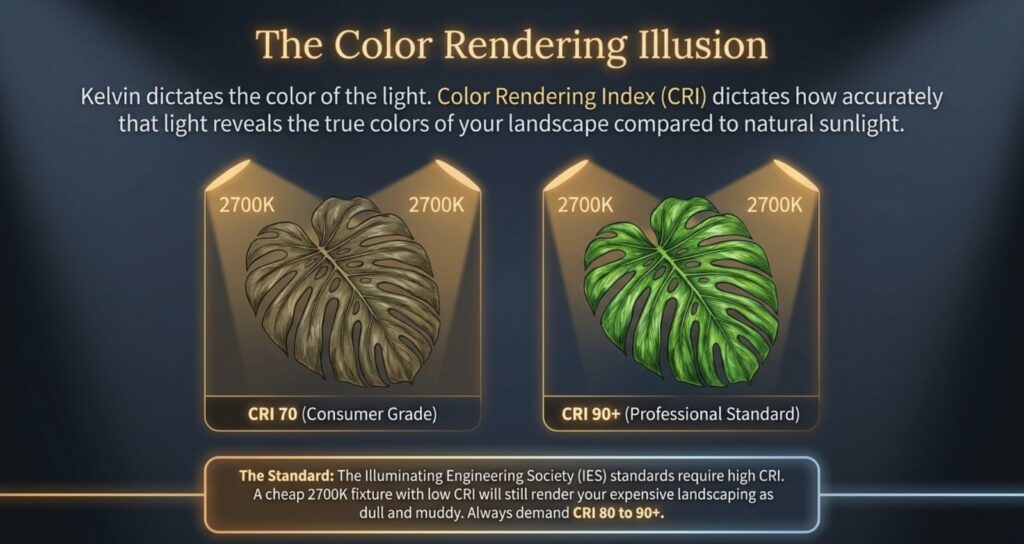
For landscape lighting, look for fixtures with a CRI of 80 or higher. Fixtures at CRI 90+ render foliage, stone, and architectural materials with exceptional accuracy. Two fixtures at the same 2700K color temperature can look noticeably different if one has a CRI of 70 and the other has a CRI of 90. The higher-CRI fixture will make greens look greener, reds richer, and stone textures more defined.
Commercial-grade fixtures typically maintain CRI 80 to 90+ as standard. Consumer-grade products vary widely and rarely publish their CRI on the packaging. When evaluating fixtures, always check the CRI specification alongside the Kelvin rating. A fixture with the right color temperature but a low CRI will still render your landscape poorly.
Quick-Reference: Color Temperature Selection by Application
| Application | Recommended Kelvin | Why |
| Tree uplighting | 2700K | Rich, warm glow on foliage and bark |
| Facade / wall wash | 2700K to 3000K | Enhances stucco, stone, brick texture |
| Path and step lights | 2700K to 3000K | Safe navigation with warm ambiance |
| String / bistro lights | 2700K | Mimics incandescent warmth |
| Deck and patio | 2700K to 3000K | Comfortable entertaining atmosphere |
| Moonlighting (downlights) | 2700K to 3000K | Natural moonlight simulation |
| Pool and water features | 3000K | Crisp visibility with warm tone |
| Security / perimeter | 4000K to 5000K | Maximum visibility, camera clarity |

Get Professional Color Temperature Selection for Your Property
Choosing the right color temperature for outdoor lighting is one detail in a larger system that needs to work together. Fixture quality, beam spread, placement angles, wiring, and control integration all interact with color temperature to produce the final result. Getting the temperature right but the placement wrong still produces a mediocre outcome.
For professional landscape lighting with warm, natural color temperatures in Newport Beach, Irvine, Laguna Niguel, or anywhere in Orange County, contact Vision Outdoor Lighting or call (949) 877-3600. Every project is owner-led, uses commercial-grade solid brass fixtures, and includes complete system documentation.
Visit our landscape lighting design page to learn more about how Vision approaches whole-property lighting systems.