

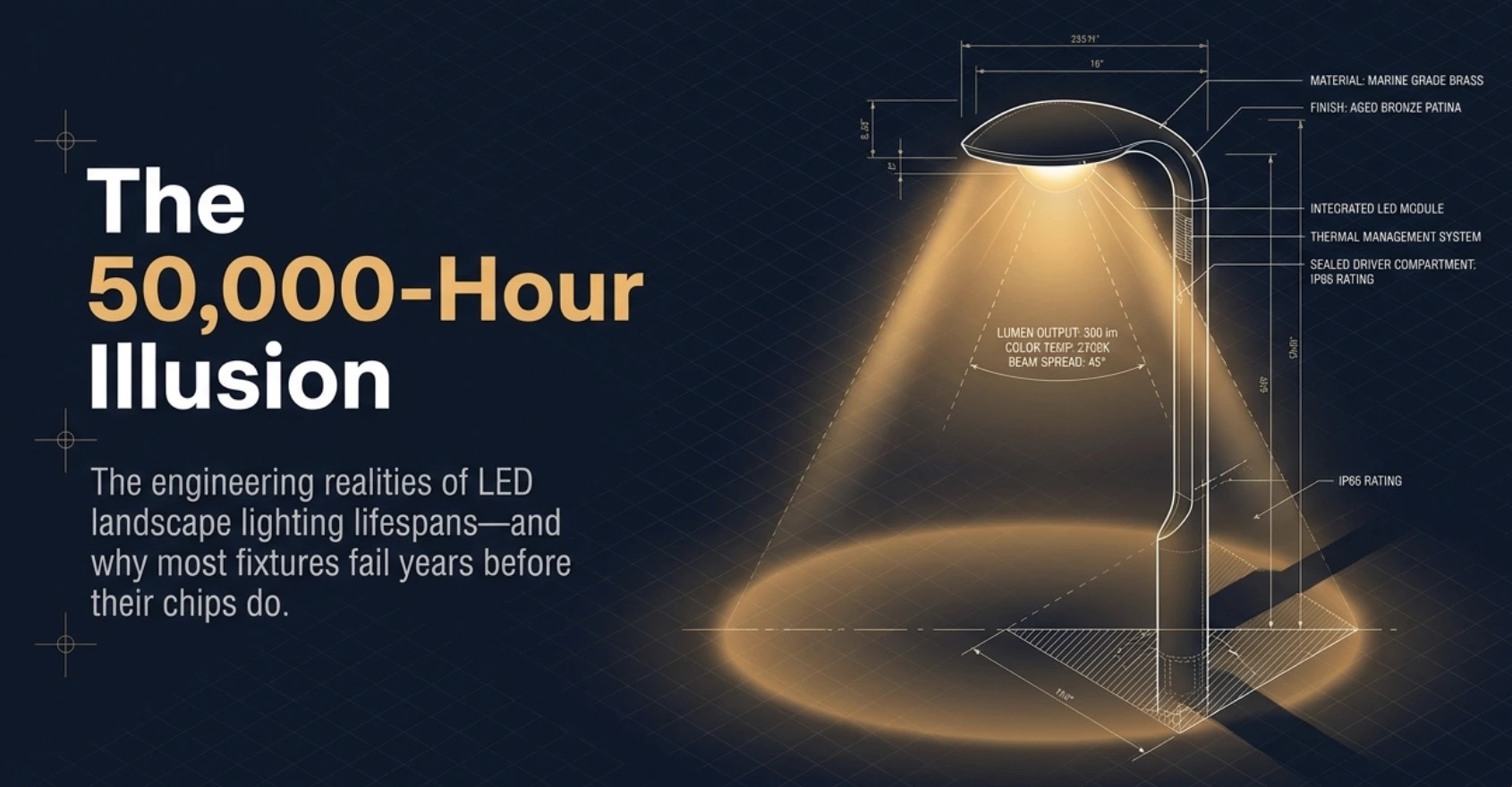
Quality LED landscape lights are rated for 50,000+ hours, which translates to roughly 15 to 20 years of nightly use. But that number assumes ideal conditions. In the real world, heat, moisture, voltage fluctuations, and cheap components shorten lifespan dramatically. Commercial-grade fixtures with quality LED drivers and solid brass housings actually deliver on the 50,000-hour promise. Big-box aluminum fixtures with low-quality drivers often fail within 2 to 5 years. The fixture housing and driver matter just as much as the LED chip itself.
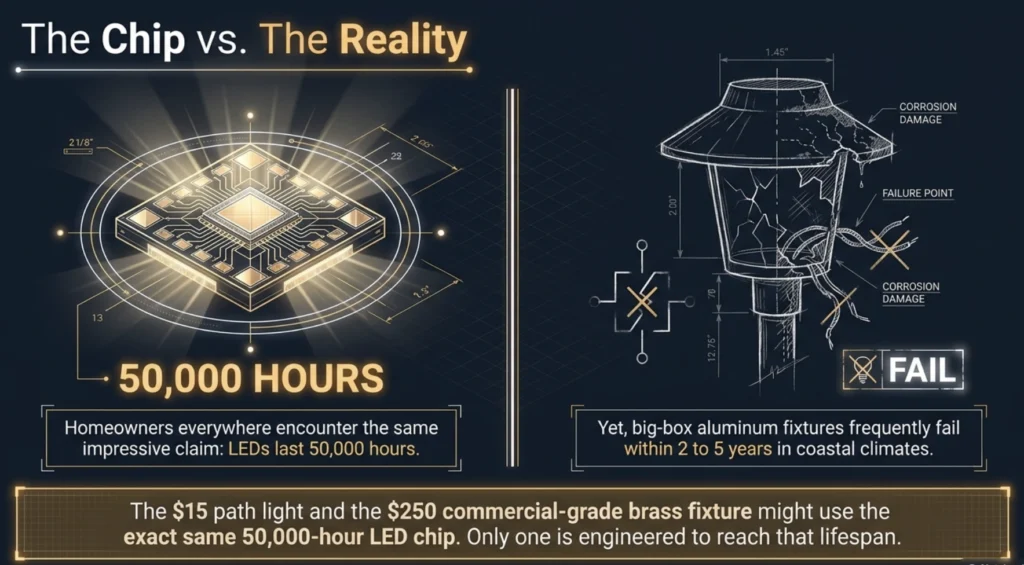
Homeowners researching landscape lighting encounter the same headline claim everywhere: LED lights last 50,000 hours. That’s an impressive number on paper, translating to over 17 years of nightly operation at 8 hours per night. But how long will LED lights last in actual outdoor conditions, exposed to heat, humidity, salt air, and constant weather cycling?
The answer depends far more on fixture quality than on the LED chip itself. A $15 big-box path light and a $250 commercial-grade brass fixture may both use LEDs rated at 50,000 hours. But only one of them is likely to reach that number. Understanding the difference is critical for homeowners making a long-term investment in landscape lighting. This guide explains why, covering LED lifespan outdoor factors, the difference between rated hours and real-world performance, and what Orange County homeowners should look for in fixtures that actually deliver long-term value.
Understanding LED Rated Lifespan: What 50,000 Hours Actually Means
LED lifespan is measured differently than traditional bulbs. Incandescent and halogen bulbs burn out completely at the end of life. LEDs don’t suddenly stop working. Instead, they gradually dim over thousands of hours in a process called lumen depreciation.
The industry standard for LED “end of life” is L70, the point at which an LED produces 70% of its original light output. According to the U.S. Department of Energy LED Basics page, quality white LED products are expected to reach L70 at 30,000 to 50,000 hours or longer. At 70% output, an LED is still producing usable light, but the reduction may be noticeable in applications where brightness consistency matters.
So do LED outdoor lights really last 50,000 hours? The LED chip itself can, if conditions are ideal. This is similar to how LED strip installation in Orange County, CA systems are often marketed based on ideal performance rather than real-world conditions. But the fixture is not just a chip. its rated hours.
Converting LED Hours to Years of Outdoor Use
Landscape lighting typically operates 6 to 10 hours per night depending on the season and timer settings. Here’s how rated hours translate to years of actual use.
| Rated Hours | 6 hrs/night | 8 hrs/night | 10 hrs/night |
| 25,000 | ~11 years | ~8.5 years | ~7 years |
| 30,000 | ~14 years | ~10 years | ~8 years |
| 50,000 | ~23 years | ~17 years | ~14 years |
| 100,000 | ~46 years | ~34 years | ~27 years |
These numbers are theoretical maximums for the LED chip under ideal laboratory conditions. Real-world LED fixture longevity depends on the factors covered in the next section.
What Affects LED Outdoor Light Lifespan in the Real World
Heat and Thermal Management
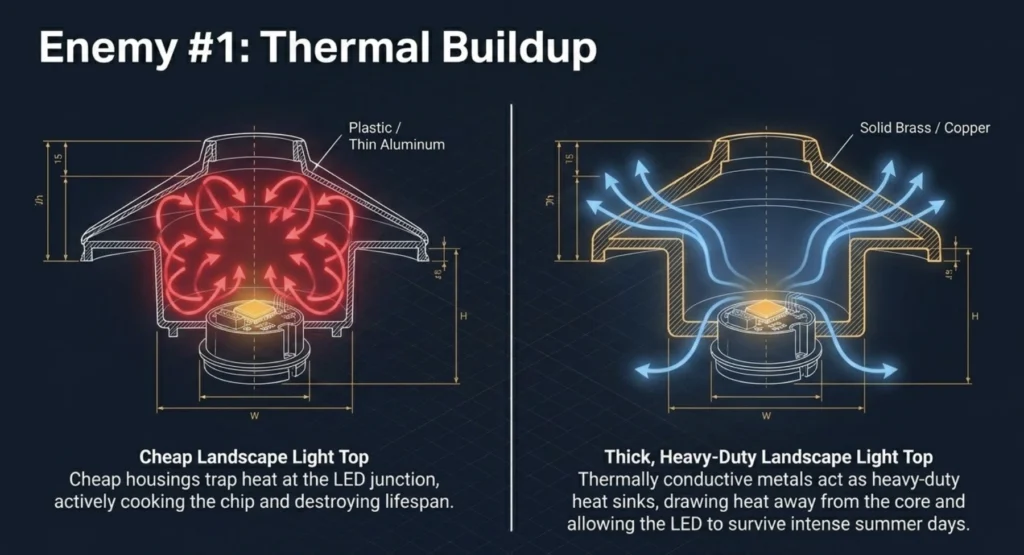
Heat is the primary enemy of LED longevity. LEDs generate heat at the junction where electricity converts to light, and that heat must be dissipated through the fixture housing. If heat builds up, it accelerates lumen depreciation and can cause premature LED failure.
Well-designed fixtures use heat sinks and thermally conductive housings (like solid brass or copper) to draw heat away from the LED junction. Cheap fixtures with plastic or thin aluminum housings trap heat, dramatically shortening LED lifespan. In Southern California, where fixtures bake in direct sun during summer, thermal management becomes even more critical.
Moisture, Salt Air, and Corrosion
Moisture intrusion is the second most common cause of LED fixture failure. When water enters the housing through degraded gaskets, cracked lenses, or poorly sealed connections, it corrodes internal components and shorts electrical pathways. The LED chip may be perfectly functional, but the fixture stops working because moisture destroyed the driver or corroded the wiring.
IP (Ingress Protection) ratings indicate how well a fixture resists moisture. IP65 is the minimum for exposed outdoor fixtures. IP67 and IP68 are required for in-ground and submersible applications. But IP ratings only matter if the seals and gaskets maintain their integrity over years of outdoor exposure. Cheap rubber gaskets degrade in UV and heat, losing their seal within a few years. Quality fixtures use silicone seals and marine-rated hardware that maintain protection for decades.
For Orange County’s coastal communities from Newport Beach to Dana Point, salt air compounds the moisture problem. Salt accelerates metal corrosion, degrades rubber seals, and attacks solder joints inside fixture housings. This is why how long LED landscape lights last varies so dramatically between inland and coastal properties. A fixture that survives 10 years in Riverside may fail in 3 years in Newport Beach if it’s not built for coastal conditions.
Voltage Fluctuations and Power Quality
LEDs are sensitive to voltage variations. In low-voltage landscape lighting systems, voltage drop across long wire runs can cause some fixtures to receive more or less power than intended. Over-voltage conditions stress LED junctions and drivers, reducing lifespan. Under-voltage causes dimming and inconsistent performance.
Professional landscape lighting installations account for voltage drop through proper wire gauge selection, strategic transformer placement, and calculated circuit design. DIY and budget installations that skip these calculations create conditions that shorten LED life even when the fixtures themselves are quality products.
Why Fixture Quality Determines How Long LED Landscape Lights Actually Last
The LED Driver Is the Weak Link
The LED driver regulates electrical current flowing to the LED chip. It is the most failure-prone component in any LED fixture, and its quality varies enormously between manufacturers.
Commercial-grade drivers use sealed, potted electronics that resist moisture, heat, and vibration. They maintain consistent current output throughout their lifespan, protecting the LED from damaging power fluctuations. Budget drivers use cheaper capacitors and components that degrade quickly, especially in hot or humid environments. When the driver fails, the fixture goes dark regardless of the LED chip’s remaining life.
As the Department of Energy explains, quality LED products use at least 75% less energy and last up to 25 times longer than incandescent lighting. But that longevity claim applies to well-engineered products, not the cheapest available option.
Housing Material Impacts Longevity
The fixture housing protects every internal component from the elements. Its material determines how well that protection holds up over years of outdoor exposure.
| Housing Material | Expected Fixture Life | Coastal Performance | Thermal Management |
| Solid Brass | 20+ years | Excellent (develops patina) | Good heat dissipation |
| Copper | 20+ years | Excellent (develops verdigris) | Excellent heat dissipation |
| Cast Aluminum | 3 to 7 years | Poor (corrodes quickly) | Moderate |
| Plastic/Composite | 1 to 3 years | Very poor (cracks, yellows) | Poor (traps heat) |
Commercial-grade solid brass fixtures provide the best combination of corrosion resistance, thermal management, and structural durability. They allow the LED chip and driver inside to reach their full rated lifespan because the housing protects them from the environmental factors that cause premature failure.
Integrated LED vs Lamp-Ready Fixtures
Integrated LED fixtures have the LED soldered directly to the circuit board inside the housing. If the LED fails, the entire fixture must be replaced. Lamp-ready fixtures accept a standard replaceable LED bulb (typically MR16 or PAR36). If a bulb fails after years of use, a $10 to $20 replacement solves the problem without touching the fixture.
For long-term landscape lighting, lamp-ready fixtures in commercial-grade housings offer the best LED bulb replacement frequency and lifetime value. The brass housing lasts 20+ years. Individual LED bulbs can be swapped as needed without replacing the entire system. For more on fixture types and their tradeoffs, see our landscape lighting tips guide.
Using Warranty as a Quality Indicator
Fixture warranties reveal what manufacturers actually expect from their products. A 1-year warranty on a fixture claiming 50,000 hours of LED life tells a clear story: the manufacturer does not expect the fixture to last anywhere near 50,000 hours. The LED chip might be rated for that duration, but the overall fixture is not built to support it.
Commercial-grade landscape lighting manufacturers stand behind their products with 15-year to lifetime warranties. This reflects confidence in the complete system: LED chip, driver, housing, seals, and connections. When evaluating LED fixture longevity claims, compare the warranty length to the rated LED hours. If there’s a significant gap, the manufacturer is essentially admitting the fixture will fail before the LED reaches its potential.
How to Maximize LED Landscape Light Lifespan
Start with quality fixtures. This is the single most impactful decision. Commercial-grade brass housings with sealed drivers and quality LED chips are engineered to deliver their full rated lifespan. No amount of maintenance can make a cheap fixture last like a quality one.
Ensure proper voltage management. Professional installation with correct wire gauge selection and transformer sizing prevents the voltage fluctuations that stress LED drivers. This is especially important on long wire runs common in larger Orange County properties.
For homeowners looking to understand how lighting choices affect overall household efficiency, working with a qualified home energy auditor can help identify opportunities to improve energy performance and reduce unnecessary energy waste.
LED Longevity in Orange County’s Coastal Climate
Orange County’s climate creates a unique combination of stresses that test LED fixture durability. Intense UV exposure during long summer days heats fixtures throughout the day before they activate at night. The marine layer delivers moisture and salt particulates that penetrate poorly sealed housings. Irrigation systems spray fixtures regularly. Landscaper activity risks mechanical damage to ground-mounted fixtures.
For homeowners in Newport Beach, Laguna Niguel, Coto de Caza, and throughout coastal Orange County, these conditions make fixture quality the single biggest factor in how long LED landscape lights last. A commercial-grade brass fixture with a sealed driver and quality LED chip will deliver 15 to 20+ years of consistent performance. A budget aluminum fixture from a big-box retailer will likely need replacement within 2 to 5 years, even if the LED chip was technically rated for decades of use.
Invest in LED Landscape Lighting Built to Last
How long will LED lights last? The honest answer: it depends entirely on what they’re built with and how they’re installed. Quality LED chips inside commercial-grade brass housings with sealed drivers, installed by professionals who account for voltage drop and proper placement, deliver the 15 to 20+ year performance that LED technology promises. Cheap fixtures with the same LED chip rating fail in a fraction of that time because the supporting components cannot withstand real outdoor conditions.
For commercial-grade LED landscape lighting built to last in Orange County’s coastal climate, contact Vision Outdoor Lighting or call (949) 877-3600. Every installation uses commercial-grade solid brass fixtures with quality LED drivers designed for 20+ years of consistent performance in Newport Beach, Irvine, Laguna Niguel, and throughout Orange County.